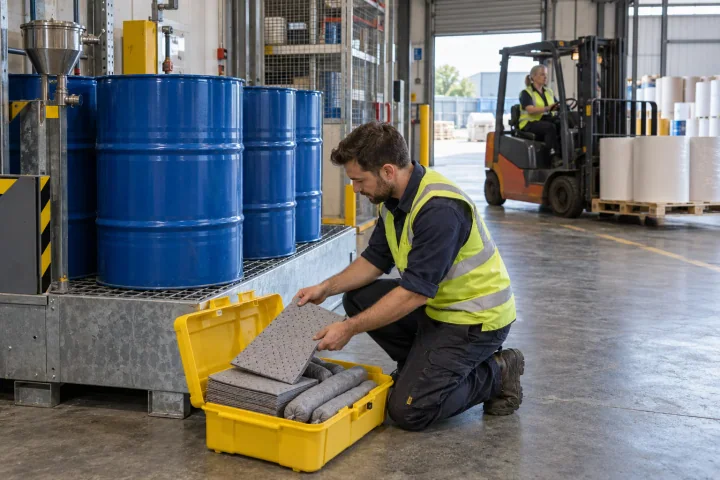
An environmental management system is how a company organises its environmental responsibilities: significant aspects, legal obligations, objectives, controls, audits and improvement. ISO 14001, in a new 2026 edition with a transition until April 2029, is the common certified standard. EMAS adds proven legal compliance, employee involvement and a public, verified environmental statement. Most companies are not legally required to have one, but customers, tenders and ratings often ask for it.
What an environmental management system is
An environmental management system is the way a company organises its environmental responsibilities: knowing which activities affect the environment, which laws apply, setting objectives, controlling the important activities and checking that it works. It is not a report or a label, but the routine behind them. ISO 14001 and the EU Eco-Management and Audit Scheme (EMAS) are the two recognised standards.
ISO 14001:2026
A new edition of ISO 14001 was published on 15 April 2026. Certificates to the 2015 edition stay valid during a 36-month transition, until April 2029 at the latest. The new edition gives more weight to environmental conditions beyond climate change, such as pollution, biodiversity and natural resources, adds a clause on planning changes, and stresses life-cycle thinking. The core is unchanged:
- An environmental policy from top management.
- The environmental aspects of your activities, products and services, and which are significant.
- Your compliance obligations: the laws and permits that apply.
- Objectives with plans to reach them.
- Operational control of significant aspects, including outsourced processes, and emergency preparedness.
- Monitoring, internal audits, management review and continual improvement.
EMAS
EMAS, under Regulation (EC) 1221/2009, includes all of ISO 14001 and asks for more. Companies must prove legal compliance, involve employees, and publish an environmental statement with core indicators on energy, materials, water, waste, biodiversity and emissions. An accredited environmental verifier validates the statement, and the company is registered with a national competent body. EMAS is less common than ISO 14001 but carries more weight with some public authorities, and in Germany it is one of the routes to meet the Energy Efficiency Act.
When you need one
No EU law requires most companies to have an environmental management system. The pressure comes from customers and tenders, which often ask for ISO 14001 or an equivalent, from ratings such as EcoVadis, which score it, and from some national energy laws that accept it in place of an energy audit or energy management system. Banks and insurers sometimes ask for it for companies with significant environmental risks.
A lighter route
For a small company, a full certified system can be more than it needs at first. Staged approaches exist, such as BS 8555 in the UK, the Green Dragon environmental standard in Wales and the ÖKOPROFIT programmes run by cities in Germany and Austria. They build the same elements step by step, and each step can lead on to ISO 14001 later. Measuring energy, emissions, water and waste in a structured way is the first step of all of them.
How certification works
An accredited certification body audits the system in two stages, first readiness and documentation, then whether it works in practice. Certificates run for three years with surveillance audits each year. The time on site depends on the number of employees, sites and the environmental complexity of the activities.
Doing it in Greener Ahead
Greener Ahead is not an environmental management system and does not certify. Carbon accounting in Greener Ahead measures energy and emissions per site from invoices, and Sustainability reporting records water, waste and your environmental policies in a VSME report, with the source behind every figure: the monitoring data an environmental management system relies on. Carbon accounting costs €1,495 and Sustainability reporting €995 per year, with unlimited users and a free 14-day trial without a card. Check the pricing page for current details.
ISO 14001 and EMAS compared
The main differences.
| ISO 14001 | EMAS | |
|---|---|---|
| Basis | International standard | EU Regulation (EC) 1221/2009, includes ISO 14001 |
| Legal compliance | Commitment to fulfil obligations | Must be demonstrated |
| Public reporting | Not required | Verified environmental statement with core indicators |
| Check | Accredited certification body | Accredited environmental verifier and registration |
| Use | Worldwide, common in tenders | Mainly in the EU, valued by public authorities |
Steps to a first system
A workable order for the first year.
- Agree an environmental policy with management.
- List your activities, their environmental aspects and which are significant.
- List the laws and permits that apply, and check you meet them.
- Set two or three objectives and start measuring energy, emissions, water and waste.
- Run an internal audit and a management review, then decide on certification.
Sources and scope
- ISO: ISO 14001 environmental management systems
- European Commission: EU Eco-Management and Audit Scheme (EMAS)
- EUR-Lex: Regulation (EC) No 1221/2009 on EMAS
These resources explain a preparation workflow. Check your selected standard and recipient requirements before sharing your report.
 Joost ThissenFounder