The Commission endorsed the VSME standard in Recommendation (EU) 2025/1710. A further voluntary-standard delegated act was adopted on 3 July 2026. The following comparison describes the adopted text; check entry into force and application before changing the basis of a report.
The Commission is explicit about why the recommendation existed at all. In its own words it "served as an intermediary solution to meet market demand pending the adoption of the voluntary standard". The adopted text provides for the recommendation to cease having effect when the new regulation enters into force.
What stayed the same
Almost all of it, and deliberately so. The Commission writes that changes to the VSME standard "have been kept to a minimum", specifically to preserve legal certainty for companies that already applied it. The two-module architecture is unchanged, and so are the disclosure codes you may already have in a spreadsheet.
| Code | Basic module disclosure |
|---|---|
| B1 | Basis for preparation |
| B2 | Practices, policies and future initiatives for transitioning towards a more sustainable economy |
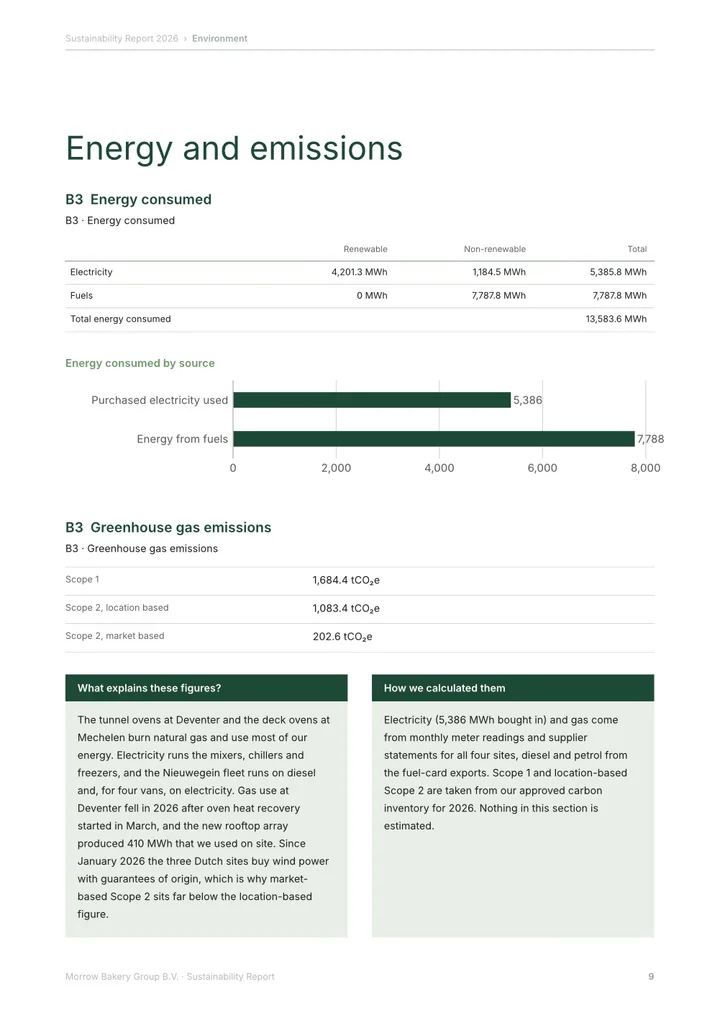
| B3 | Energy and greenhouse gas emissions |
| B4 | Pollution of air, water and soil |
| B5 | Biodiversity |
| B6 | Water |
| B7 | Resource use, circular economy and waste management |
| B8 | Workforce, general characteristics |
| B9 | Workforce, health and safety |
| B10 | Workforce, remuneration, collective bargaining and training |
| B11 | Convictions and fines for corruption and bribery |
The comprehensive module keeps its nine disclosures, C1 to C9, covering strategy, transition practices, reduction targets and climate transition, climate risks, additional workforce characteristics, human rights policies and incidents, revenues from certain activities, and the gender diversity ratio in the governance body.
What changed
Three things, and all three are in your favour.
- Fewer datapoints. The content was aligned with the revised set of ESRS, which reduced the number of datapoints compared with the VSME standard.
- A published list of what is capped. The act carries an Annex II that lists exactly which disclosures sit under the value chain cap. Until now, arguing about the boundary meant arguing about interpretation. Now it means pointing at an annex.
- A carve-out for the smallest companies. For an undertaking with 10 employees or less, certain disclosures, in particular the more challenging environmental ones, are voluntary. Those disclosures sit above the cap for such a company, which means a customer may not require them at all.
Who may use it
Wider than before. The old recommendation was aimed at non-listed SMEs, which most people read as under 250 employees. The voluntary standard is available to undertakings that do not exceed an average of 1000 employees and wish to report on a voluntary basis. The Commission's reasoning is worth quoting, because it explains why the standard did not grow: "Any significant addition to the VSME standard would increase the reference level for the value chain cap, lowering the protection for undertakings in value chains."
A bigger standard would have been a worse deal for the companies it protects. They kept it small on purpose.
If you already reported under VSME
Your work stands. The datapoints are substantially the same, the codes are the same, and continuity for existing preparers was an explicit design goal. What you should do is re-check two things: whether any disclosure you answered has been dropped in the alignment with the revised ESRS, and, if you have 10 employees or fewer, which of the environmental disclosures you no longer have to answer at all.
For the record, the act came out of a four-week "Have Your Say" consultation that ran from 6 May to 3 June 2026 and drew 203 responses. For a technical annex to an accounting directive, that is a crowd.
 Joost Thissen