A sustainability or ESG strategy is a short set of choices: the few topics where your company will act, the target for each, the actions and budget to reach it, who is responsible and how progress is reported. Build it from your own impacts and from what customers, banks and employees ask, not from a list of every possible topic.
What a sustainability strategy is
A sustainability or ESG strategy is a set of choices: the few topics where your company will act, what it wants to achieve by when, how it will get there and who is responsible. It is different from a policy, which states commitments, and from a report, which shows results. A good strategy fits on one page and is tied to the business plan, because the actions cost money and change how the company works.
The six steps
Most companies follow the same order.
- Know where you stand: your carbon footprint, energy use, waste, workforce and safety figures.
- Listen to your readers: what customers, banks, employees and public buyers ask for.
- Choose three to five priorities where your impact is largest and your readers care most.
- Set a target for each priority, with a base year, a target year and a figure.
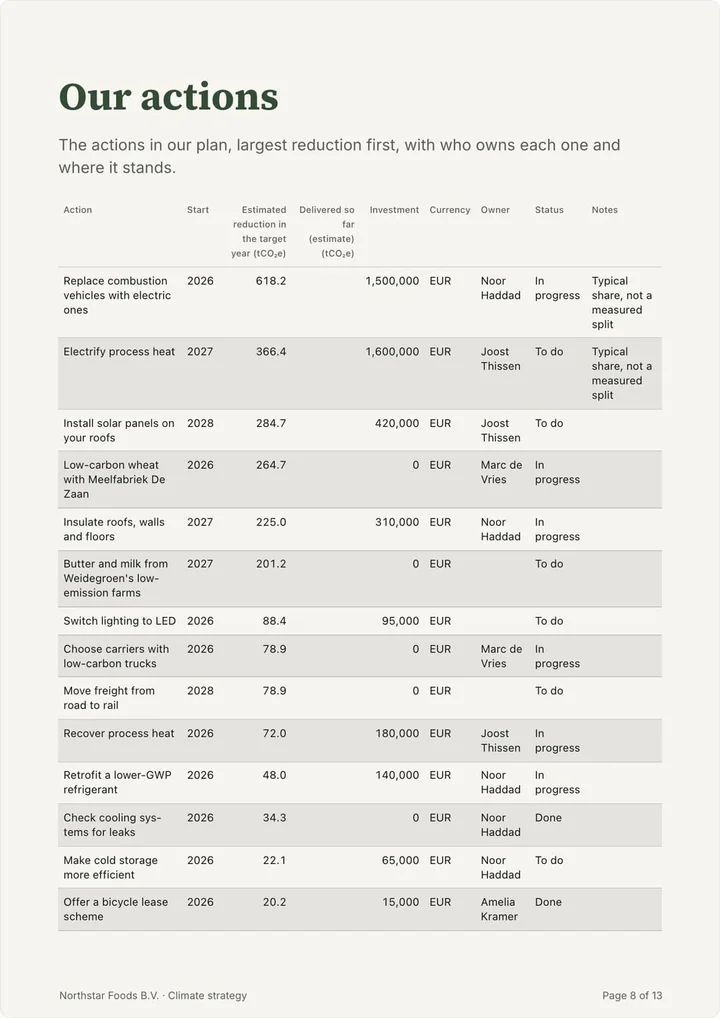
- Plan the actions, with cost, expected result, timing and an owner, and put them in the budget.
- Report progress every year, including what did not work.
Choosing priorities
Not every topic deserves equal attention. A simple test is the one behind double materiality: how large is your impact on people and the environment, and how much does the topic affect your business, through costs, customers, financing or risks? A transport company will end up with fuel and road safety; a food producer with energy, packaging and food waste; an office business with travel, energy and its people. Topics with low scores on both stay in your policy but do not need their own targets.
Targets and actions
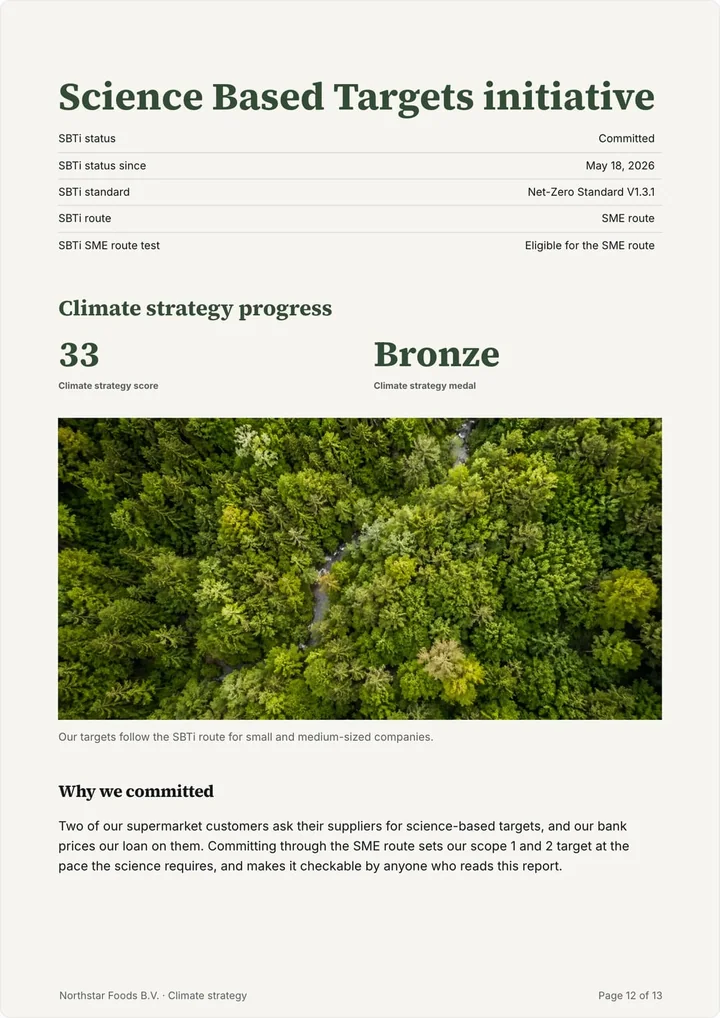
Express targets in figures your company already measures, such as tonnes of CO₂, kilowatt hours, kilos of waste or lost-time accidents, so progress can be checked. For emissions, a target in line with the Paris Agreement, for example through the Science Based Targets initiative’s route for smaller companies, is what banks and large customers increasingly expect.
For each target, list the actions that will get you there, with what each one costs, what it saves and when it pays back. If the actions do not add up to the target, either the target or the plan has to change.
Ownership and reporting
Give each priority an owner on the management team and review progress every quarter. Report once a year in a standard structure, such as the EU voluntary standard (VSME), so readers can compare one year with the next. A strategy that is never reported quietly disappears.
Doing it in Greener Ahead
Carbon accounting in Greener Ahead gives you the baseline a strategy starts from, with Scope 1, 2 and all 15 Scope 3 categories, and compares every year with the base year. It costs €1,495 per year with unlimited users. Climate strategy, coming soon, adds targets, the measures available to you with their cost and saving, and progress against the path you chose. Sustainability reporting turns the result into a VSME report for €995 per year. You can try both free for 14 days without a card. Check the pricing page for current details.
A strategy on one page
An example for a fictional food wholesaler with a cold store and a delivery fleet.
| Priority | Target | Main actions | Owner |
|---|---|---|---|
| Emissions from deliveries | 30% less CO₂ per delivery by 2030 compared with 2025 | Route planning, electric vans for city routes | Logistics manager |
| Energy in the cold store | 25% less electricity per pallet by 2028 | LED lighting, door curtains, heat recovery | Facility manager |
| Food waste | Half the food waste by 2030 | Better forecasting, donating surplus food | Purchasing manager |
| Safe work | No lost-time accidents | Forklift training, a new warehouse layout | Operations director |
| Responsible purchasing | All main suppliers signed the code of conduct by 2027 | Supplier code of conduct and questionnaire | Purchasing manager |
Signs a strategy exists only on paper
Readers who see these assume nothing will change.
- More than six priorities.
- Targets without a base year or a figure.
- No budget for the actions.
- Nobody on the management team owns it.
- Progress is never reported, or only the good news.
Sources and scope
- GHG Protocol: Corporate Accounting and Reporting Standard
- SBTi: how it works
- European Commission: 2025 VSME recommendation and standard
These resources explain a preparation workflow. Check your selected standard and recipient requirements before sharing your report.
 Joost ThissenFounder