ESOS phase 4 applies to UK organisations that, on 31 December 2026, employ at least 250 people or have turnover above £44 million and a balance sheet above £38 million, and to UK companies in their group. By 5 December 2027 they must measure total energy use over 12 months, audit at least 95% of it or cover it with ISO 50001, have a lead assessor review it, get director sign-off and notify compliance, and keep reporting progress on their action plan.
What ESOS is
The Energy Savings Opportunity Scheme (ESOS) is the UK’s mandatory energy assessment scheme for large organisations, set up by the ESOS Regulations 2014. It runs in four-year phases. Each phase, qualifying organisations measure their total energy use, have the significant part of it audited to find cost-effective savings, and notify compliance to the scheme administrator. The Environment Agency administers it for the whole UK.
Who qualifies for phase 4
An organisation takes part in phase 4 if, on the qualification date of 31 December 2026, it is a large undertaking: it employs at least 250 people, or it has an annual turnover above £44 million and a balance sheet total above £38 million. A UK company that belongs to a group with a large undertaking is also in, and the group usually complies together. Employees include part-time staff, owners and partners.
What compliance takes
The phase 4 compliance date is 5 December 2027. By then an organisation must:
- Measure its total energy use for buildings, industrial processes and transport over a continuous 12-month reference period that includes the qualification date.
- Identify the areas that make up at least 95% of that total, its significant energy consumption.
- Have those areas audited, or covered by a valid ISO 50001 certificate, and calculate energy intensity metrics.
- Have a registered lead assessor review the assessment, unless ISO 50001 covers it or total use is below 40,000 kWh.
- Get sign-off from a board-level director and notify compliance in the online portal.
Action plans and progress updates
Since phase 3, organisations must also publish an action plan of the energy-saving measures they intend to take, with targets, and report progress against it every year, signed by a director. Phase 3 participants submit their next annual progress update by 5 December 2026. In phase 4, the assessment must show progress against the earlier commitments and explain any measure that was not carried out. Display Energy Certificates and Green Deal assessments no longer count as compliance routes.
What is still to come
The government had planned to add net zero elements to ESOS and align its qualification thresholds with Streamlined Energy and Carbon Reporting. Those changes were postponed to phase 5. Full guidance for phase 4 is expected in early 2027. The regulators can impose civil penalties for failing to comply and publish the names of the organisations concerned.
Preparing the energy data
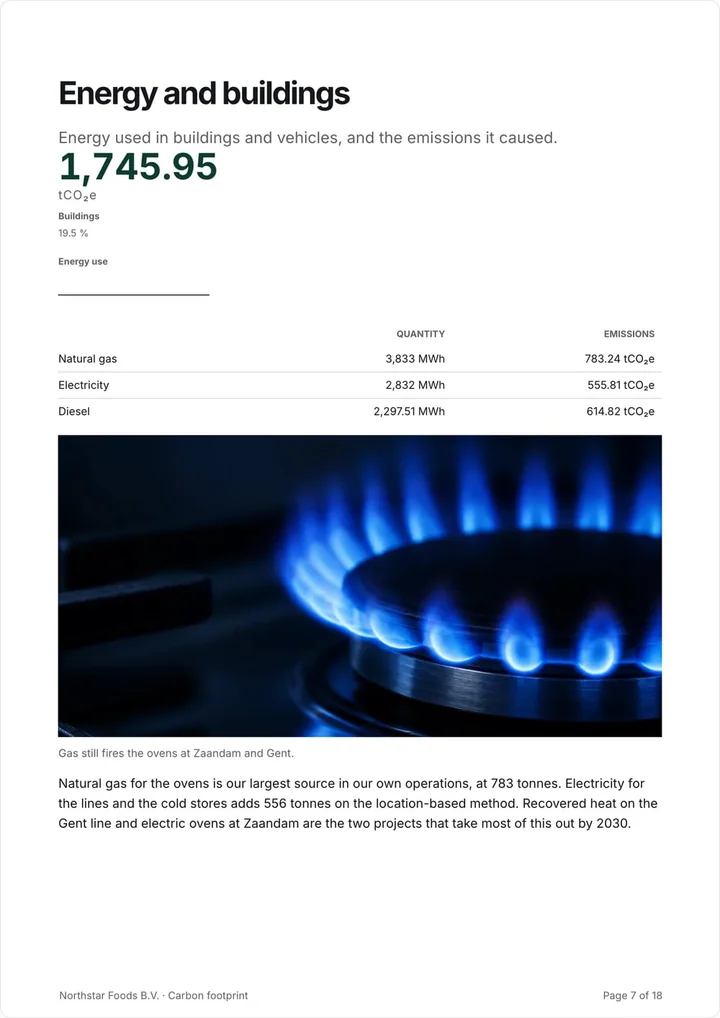
Start the reference period data now. Collect gas and electricity per site from half-hourly data or invoices, fuel cards and mileage claims for vehicles, and any oil, LPG or district heat. Convert everything to kWh, sort it by buildings, processes and transport, and the 95% split follows. The same data feeds your SECR figures in the directors’ report.
Doing it in Greener Ahead
Greener Ahead does not carry out ESOS audits or act as a lead assessor. Carbon accounting in Greener Ahead records energy use per site and energy carrier from invoices, meter readings and fuel records, totals it in kWh for buildings and transport, turns it into Scope 1 and 2 emissions and compares every year with the last. It costs €1,495 per year with unlimited users, and you can try it free for 14 days without a card. Check the pricing page for current details.
ESOS phase 4 at a glance
The main rules and dates.
| Rule | What it means |
|---|---|
| Qualification date | 31 December 2026 |
| Who | 250 or more employees, or turnover above £44 million and balance sheet above £38 million |
| Compliance date | 5 December 2027 |
| Energy audited | At least 95% of total energy use |
| Alternative route | ISO 50001 certificate covering the significant energy consumption |
| Lead assessor | Required, unless ISO 50001 covers it or total use is below 40,000 kWh |
| Ongoing | Action plan with annual progress updates signed by a director |
Steps to compliance
A workable order for phase 4.
- Confirm on 31 December 2026 which group companies qualify.
- Choose a 12-month reference period and collect energy data for buildings, processes and transport.
- Find the areas that make up 95% of the total.
- Book audits, or check that your ISO 50001 certificate covers them.
- Have the lead assessor review, get director sign-off and notify before 5 December 2027.
Sources and scope
- GOV.UK: Comply with the Energy Savings Opportunity Scheme (ESOS)
- legislation.gov.uk: The Energy Savings Opportunity Scheme Regulations 2014
These resources explain a preparation workflow. Check your selected standard and recipient requirements before sharing your report.
 Joost ThissenFounder