Under the recast EU Energy Efficiency Directive, a company’s energy use decides its duty, not its size. Companies using more than 10 TJ (about 2.8 GWh) a year on average without a certified energy management system must carry out an energy audit by 11 October 2026 and every four years after. Companies above 85 TJ (about 23.6 GWh) must have a certified energy management system by 11 October 2027. Audit recommendations become an action plan that is made public.
From company size to energy use
Under the old Energy Efficiency Directive, every large company had to carry out an energy audit every four years, whatever it used. The recast directive, Directive (EU) 2023/1791, changed the test. Article 11 now looks at how much energy a company uses: its average annual final energy consumption over the previous three years, across electricity, gas, heating oil, vehicle fuel and district heat together. A small company with a heavy process can now be in scope, and a large office company can fall out.
The two thresholds
Companies above 85 TJ a year, about 23.6 GWh, must run an energy management system, certified by an independent body, by 11 October 2027. Companies above 10 TJ, about 2.8 GWh, that do not have such a system must carry out an energy audit by 11 October 2026 and repeat it at least every four years. A company with a certified energy management system is not subject to the separate audit duty.
Member States had until 11 October 2025 to put this into national law, and several are late. Until a country has amended its law, its old rules can still apply, including a test based on company size. Check the national law for the exact dates, the authority and any reporting portal.
What an energy audit covers
Annex VI of the directive sets minimum criteria. An audit must be:
- Based on up-to-date, measured and traceable data on energy use, and on load profiles for electricity where available.
- A detailed review of the energy use of buildings, industrial processes and transport.
- Built on life-cycle cost analysis, so savings over the life of a measure count, not only the payback.
- Proportionate and representative enough to give a reliable picture of overall energy performance.
- Carried out independently by qualified or accredited experts, often following the EN 16247 series.
The action plan
The audit is not the end. Companies have to turn its recommendations into a concrete and feasible action plan and present it to management. The directive also requires the action plan and the share of recommendations carried out to be made public, for example in the annual report. The next audit four years later shows whether the measures were taken.
Counting your energy use
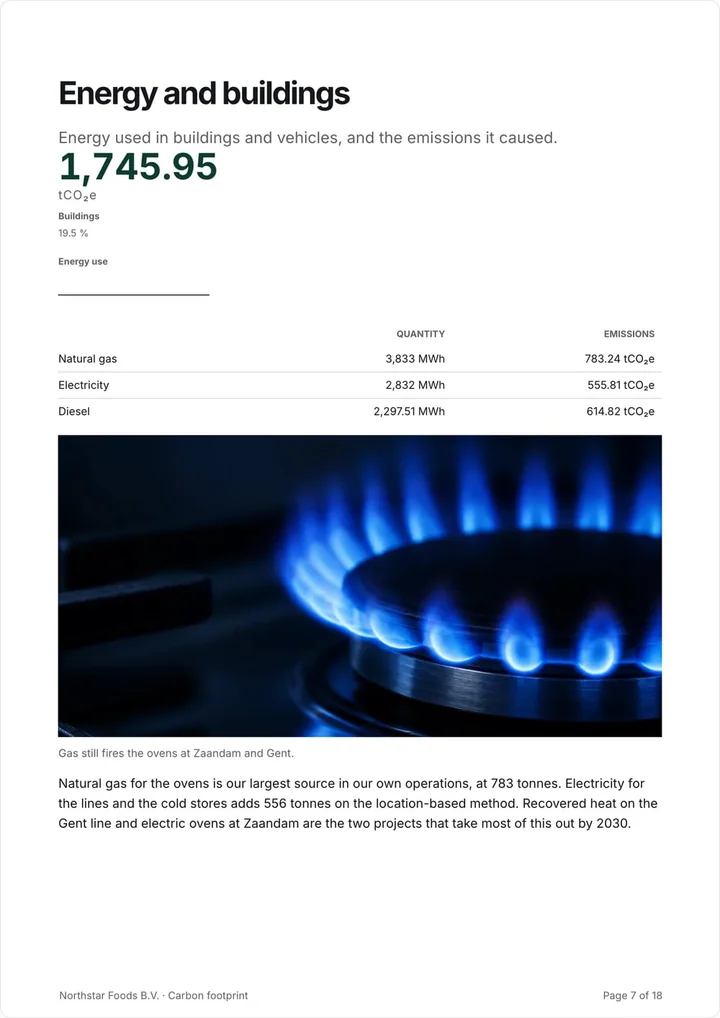
10 TJ is 2,778 MWh. Add up all final energy from a full year of invoices: electricity and gas in kWh, heating oil and vehicle fuel converted to kWh, and district heat. A litre of diesel holds about 10 kWh. A company that uses 1.8 GWh of electricity and 120,000 litres of diesel for its vans already uses about 3 GWh, above the audit threshold. Average three years, because one unusual year does not decide it.
Doing it in Greener Ahead
Greener Ahead does not carry out energy audits. Carbon accounting in Greener Ahead records your energy use per site and energy carrier from invoices and meter readings, totals it in kWh, which shows where you stand against the thresholds, and turns it into Scope 1 and 2 emissions. Comparing every year with the last shows whether the audit’s measures worked. It costs €1,495 per year with unlimited users, and you can try it free for 14 days without a card. Check the pricing page for current details.
Thresholds at a glance
Article 11 of Directive (EU) 2023/1791.
| Average annual energy use | Duty | Deadline |
|---|---|---|
| Above 85 TJ (about 23.6 GWh) | Certified energy management system | 11 October 2027 |
| Above 10 TJ (about 2.8 GWh), no certified system | Energy audit, repeated at least every four years | First audit by 11 October 2026 |
| Either group | Action plan from the recommendations, made public | After each audit |
| Below 10 TJ | No duty under the directive | Member States offer support programmes |
Before the auditor arrives
These preparations make the audit faster and more useful.
- Collect three years of energy invoices per site and energy carrier.
- Gather interval data for electricity where your supplier or meter provides it.
- List the main energy users: furnaces, compressors, cooling, ventilation, lighting, vehicles.
- Note production volumes per year, so energy can be compared per unit.
- Agree who in management will receive and approve the action plan.
Sources and scope
- EUR-Lex: Directive (EU) 2023/1791 on energy efficiency
- European Commission: energy efficiency directive
These resources explain a preparation workflow. Check your selected standard and recipient requirements before sharing your report.
 Joost ThissenFounder