A sustainability report describes a year of your company’s environmental, social and governance performance in figures and short descriptions. Unless EU law requires you to report under the ESRS, use the EU voluntary standard (VSME) as the structure: the eleven Basic disclosures cover energy, emissions, waste, workforce and business conduct, and the Comprehensive module adds targets, climate risks and human rights. Collect the evidence first, write second.
What a sustainability report is
A sustainability report describes how your company performs on environmental, social and governance topics over one year. It combines figures, such as energy use, greenhouse gas emissions, waste, headcount and work accidents, with short descriptions of your policies, targets and the actions behind them. Depending on the country and the reader it is called a sustainability report, an ESG report, a CSR report or a non-financial statement. The content is largely the same.
Since the 2026 Omnibus, EU law requires a sustainability report only from companies with more than 1,000 employees and more than €450 million turnover. Everyone else writes one voluntarily, usually because a customer, a bank or a tender asks for it. That changes the brief: the report has to answer the people who asked, with figures they can check.
Which standard to follow
Companies inside the CSRD report under the European Sustainability Reporting Standards (ESRS). For everyone else the obvious choice is the EU voluntary standard, known as VSME, which the Commission recommended in July 2025 (Recommendation (EU) 2025/1710). It is free, it was written for companies with up to 1,000 employees, and it is what banks and large customers are asked to accept. Under the value chain cap, from financial year 2027 a customer that reports under the CSRD may not require more than this standard covers from a company in its value chain with 1,000 employees or fewer.
Other frameworks exist. The GRI Standards are used worldwide, mostly by large companies, and some countries have their own codes, such as the DNK in Germany. They are not wrong, but they ask for more than most readers need. Start with VSME, and add a specific question from another framework only when a reader asks for it.
What goes in it
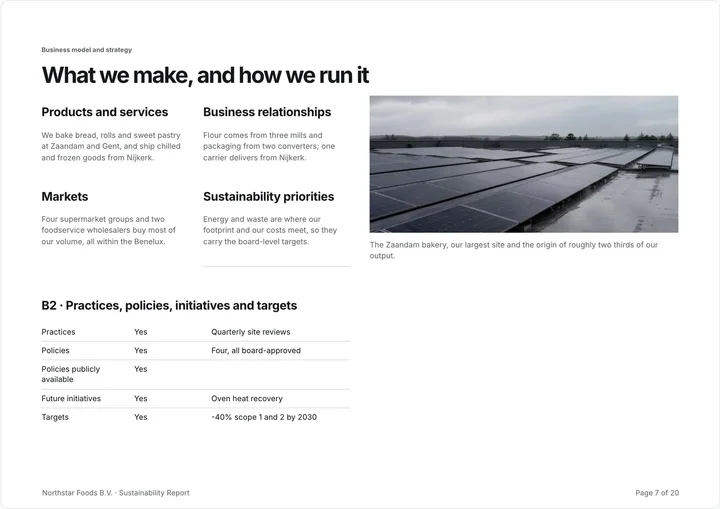
A VSME report has two modules. The Basic module has eleven disclosures, B1 to B11, and is the minimum every report needs: how the report was prepared, your policies and actions, energy and emissions, pollution, biodiversity, water, resources and waste, your workforce, health and safety, pay and training, and convictions for corruption or bribery. The Comprehensive module adds nine disclosures, C1 to C9, for readers who want more: your strategy and business model, reduction targets and a transition plan, climate risks, human rights and the gender balance of your board.
You report only what applies. A disclosure that does not apply to your business is explained in a sentence rather than left out, and companies with ten employees or fewer may skip some of the harder environmental disclosures. The table below shows each Basic disclosure with the records it is usually built from.
How to write it, step by step
Most of the work is collecting and checking figures. The writing itself takes the least time when the figures are right.
- Agree the brief: who will read the report, what they will use it for and which year it covers.
- Set the boundary: the legal entities and sites included, the same as in your annual accounts.
- Choose the module: Basic, or Basic plus the Comprehensive disclosures your readers ask about.
- Collect the evidence: bills, meter readings, payroll and HR records, waste invoices, with an owner for every figure.
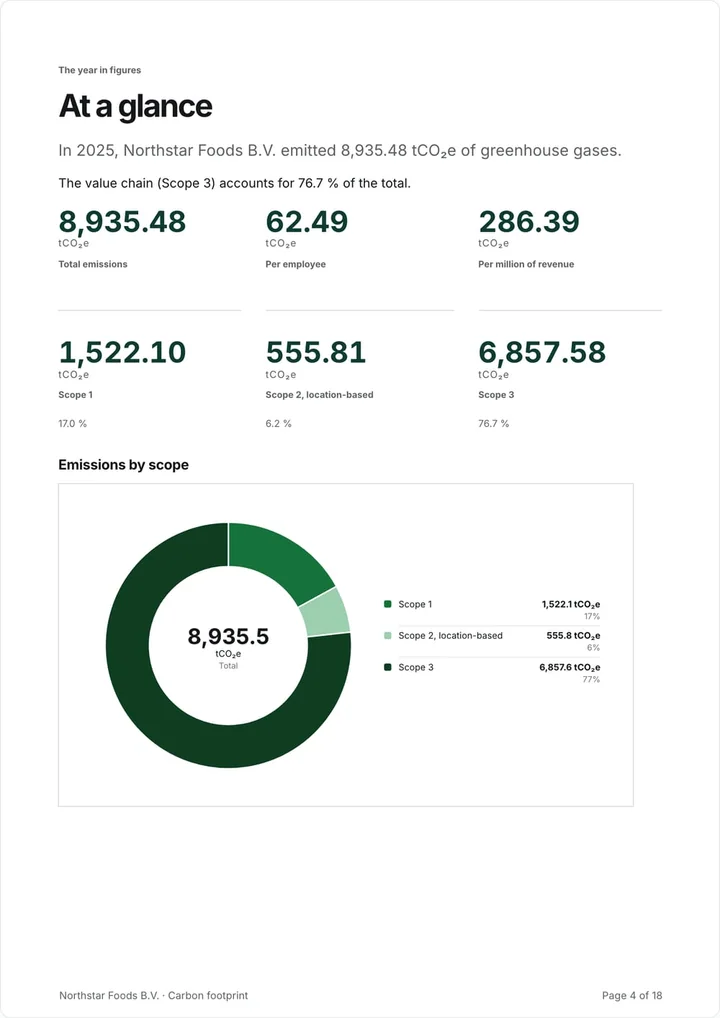
- Calculate: energy in kWh and emissions in tonnes of CO₂ equivalent, with the emission factor and its source.
- Write the text: short, factual descriptions of policies and targets; no claim you cannot back up.
- Review and approve: a second person checks the figures against the evidence, and a director signs off.
- Share and update: send the same report to everyone who asks, and update it each year with your annual accounts.
Doing it in Greener Ahead
Sustainability reporting in Greener Ahead follows the VSME standard disclosure by disclosure. It shows only the disclosures that apply, lets your documents fill in the figures, keeps the evidence beside every answer and turns the result into a designed report you can share by link or export. It costs €995 per year with unlimited users, and you can try it free for 14 days without a card. Check the pricing page for current details.
The Basic module, disclosure by disclosure
Every VSME report starts with these eleven disclosures. The last column is where the figures usually come from.
| Disclosure | What it covers | Typical records |
|---|---|---|
| B1 Basis for preparation | Module chosen, entities and sites included, reporting period | Company register extract, annual accounts |
| B2 Practices, policies and future initiatives | Policies and actions on environment, people and business conduct | Policy documents, codes of conduct |
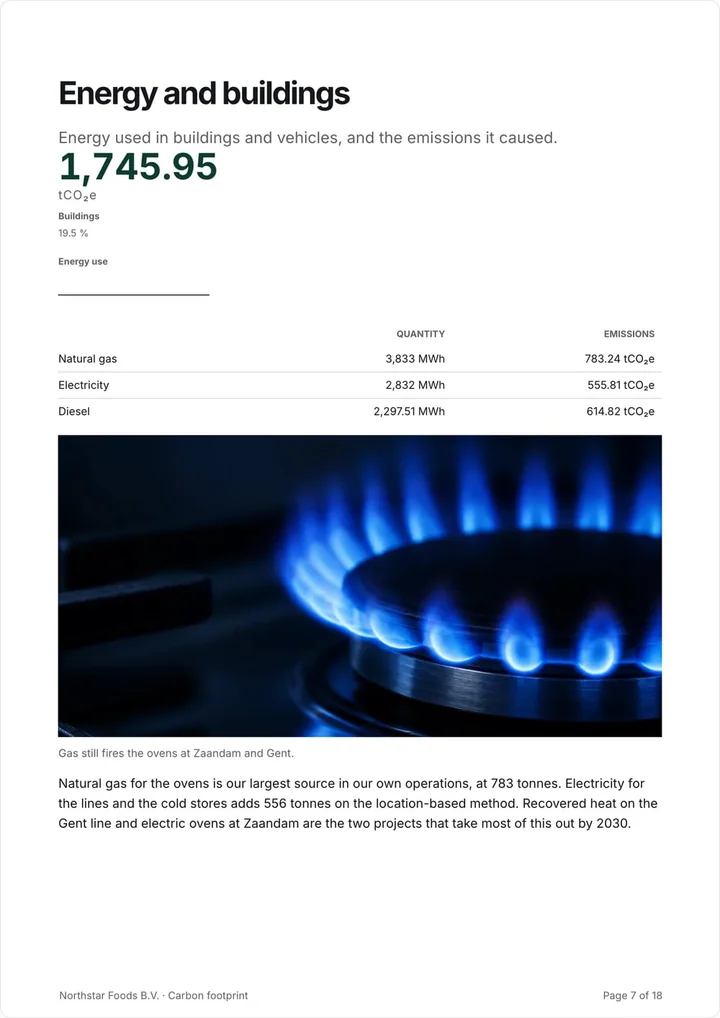
| B3 Energy and greenhouse gas emissions | Energy use and Scope 1 and 2 emissions, optionally Scope 3 | Energy bills, meter readings, fuel cards |
| B4 Pollution of air, water and soil | Pollutants you must already report under permits or law | Permits, emission reports |
| B5 Biodiversity | Sites in or near protected areas, land use | Site addresses, land registry |
| B6 Water | Water withdrawal, and consumption in water-stressed areas | Water bills, meter readings |
| B7 Resource use, circular economy and waste | Waste by type and treatment, material use | Waste invoices, transfer notes |
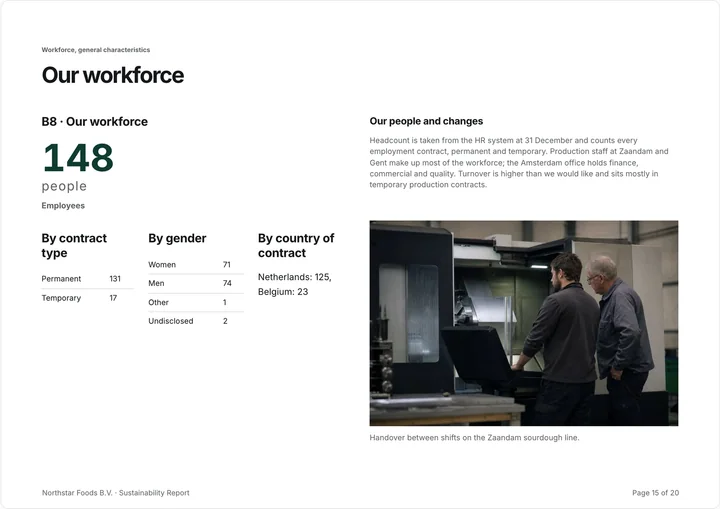
| B8 Workforce: general characteristics | Employees by contract type, gender and country, turnover | Payroll and HR records |
| B9 Workforce: health and safety | Recordable work accidents and fatalities | Accident register |
| B10 Workforce: pay, collective bargaining and training | Minimum wage, gender pay gap, agreements, training hours | Payroll, collective agreement, training records |
| B11 Convictions and fines for corruption and bribery | Number of convictions and the fines paid | Legal records, statement by the board |
Mistakes that weaken a report
A reader who knows the topic will look for these first.
- Claims without figures, such as “climate neutral” or “sustainable”, with no evidence behind them.
- Figures from different periods or entities mixed in one report.
- Estimates that are not labelled as estimates, or have no method.
- A zero where the figure is actually unknown.
- A designed report before the figures have been reviewed.
Questions to settle before you write
Answer these in a sentence each and keep them with the report. They decide most of what follows.
- Who asked for the report, and what will they do with it?
- Which year, which entities and which sites does it cover?
- Basic module only, or Basic plus Comprehensive disclosures?
- Who owns each figure, and who approves the final report?
- Will you publish it, or send it only to the readers who asked?
Sources and scope
- European Commission: 2025 VSME recommendation and standard
- EFRAG: digital template, example and explanatory notes
- Directive (EU) 2026/470 (Omnibus I), EUR-Lex
- GRI: the GRI Standards
These resources explain a preparation workflow. Check your selected standard and recipient requirements before sharing your report.
 Joost ThissenFounder