Under the 2025 VSME recommendation, Comprehensive builds on Basic. B1 distinguishes Option A (Basic only) and Option B (Basic plus Comprehensive). Make your selection from the reporting purpose and applicable disclosures, then document the basis clearly.
Choose for the reader and the reporting purpose
The 2025 VSME standard has a Basic module and an additional Comprehensive module. Use the official text to identify the disclosures and applicability conditions for the version you are reporting against.
Do not decide from the names alone. Make a list of what your customer or bank actually needs. A short, well-evidenced response can be more useful than a larger document that contains unanswered questions.
A practical decision process
Suppose a customer asks a supplier for a first sustainability overview. The supplier should map that request to the standard, identify the applicable disclosures and discuss any extra needs with the recipient. If the recipient asks for more detail, record the purpose and the evidence required.
- Name the standard and reporting period.
- Map recipient questions to the disclosures.
- Identify the extra work and data owners.
- Confirm the scope with the internal approver.
- Explain the chosen basis in the report.
Review scope each year
Your business, sites and readers can change. Revisit the scope rather than assuming last year’s choice is automatically right. Keep the reason for your decision so a colleague can understand it later.
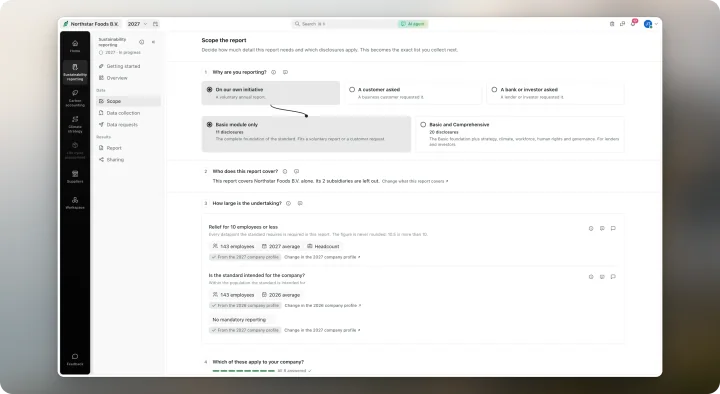
In Greener Ahead, scope comes before answering disclosures. Use that stage to make the reporting task clear, then check that the document matches the scope you selected.
Compare the two reporting options
Annex I paragraphs 5–6 establish the module relationship, and paragraph 24 requires the selected option in B1. Paragraph 22 also allows Basic reporting to be supplemented with selected Comprehensive metrics. If you do that, state the basis and additions clearly rather than implying you completed Option B.
| Question | Basic only | Basic plus Comprehensive |
|---|---|---|
| Foundation | B1–B11, with applicability conditions | The Basic foundation plus C1–C9, with applicability conditions |
| Purpose | A structured sustainability starting point | Additional information relevant to more detailed reader needs |
| Additional topics | Selected additions can be explained separately | Business model, climate, workforce, human rights and governance detail |
| Preparation consequence | Collect and review the applicable Basic information | Allocate owners and evidence for the additional disclosures |
| Statement in B1 | Option A | Option B |
Work through a real request before choosing
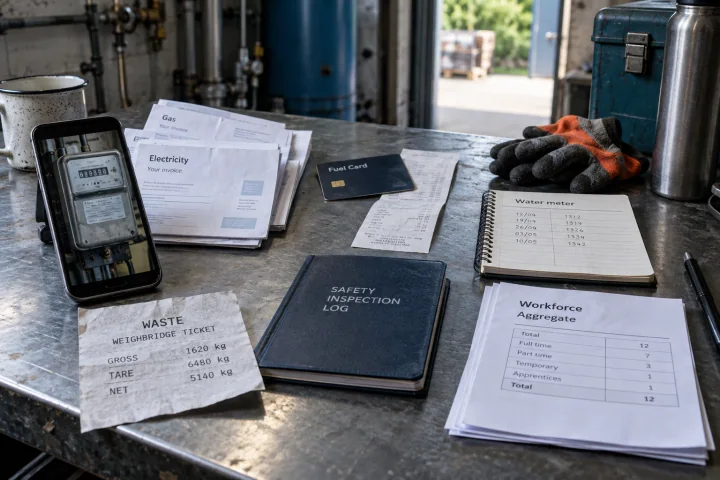
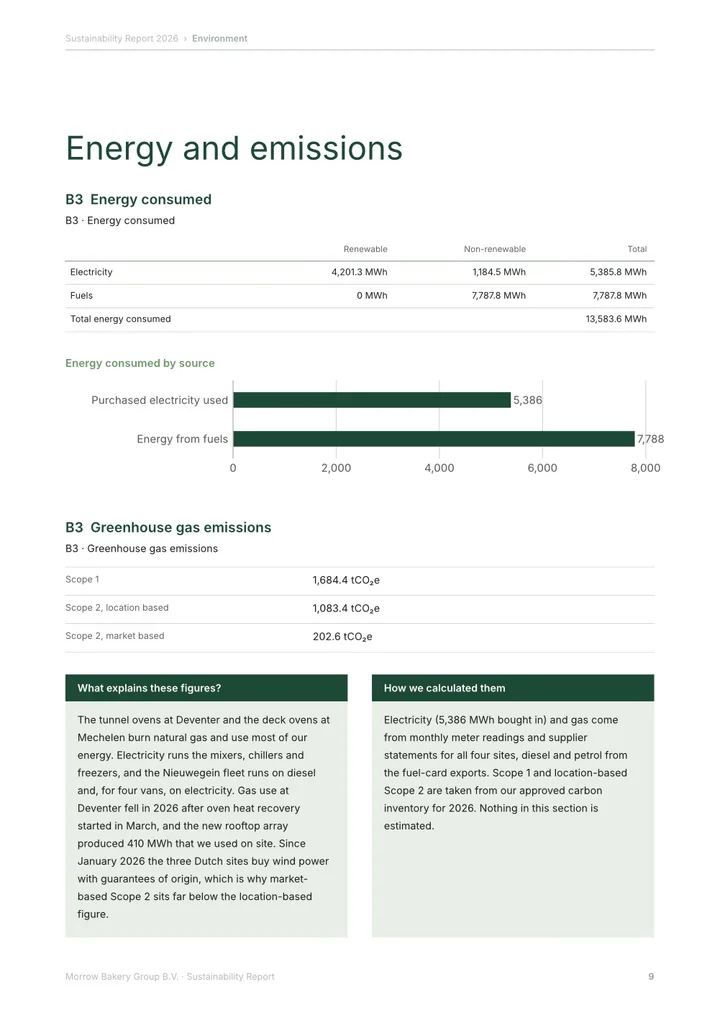
Imagine a customer asks for electricity use, workforce totals and safety information. Map those questions to B3, B8 and B9, then review the other applicable Basic disclosures before describing the output as a Basic report. The customer’s three questions alone do not establish completeness.
If a bank also asks about climate risks or reduction targets, map those requests to the relevant Comprehensive disclosures and identify the evidence needed. Discuss unclear requests with the recipient. Do not select a module solely because the requester is a bank, or because one option sounds more credible.
Keep applicability separate from data availability
A disclosure can apply even when its data is difficult to collect. Treat that as an evidence problem. Conversely, a condition may not apply to your business even when an empty field appears in a template. Record the reason for the applicability decision so a reviewer can reconstruct it.
The toolkit fixes its disclosure references to Recommendation (EU) 2025/1710. The July 2026 delegated act is a separate instrument with its own provisions. When using another basis, check the relevant text and update the mapping instead of silently mixing versions.
Sources and scope
These resources explain a preparation workflow. Check your selected standard and recipient requirements before sharing your report.
 Joost ThissenFounder