The BDESE is the database every French employer with 50 or more employees keeps for its social and economic committee (CSE). One of its ten themes is the environmental consequences of the company’s activity. Without a company agreement, the decree of 26 April 2022 requires the company’s environmental organisation, hazardous waste, water and energy consumption, its Scope 1 emission sources and their volume where known, and the greenhouse gas report for companies that must prepare one.
What is the BDESE?
The BDESE (base de données économiques, sociales et environnementales) is the database a French employer with 50 or more employees keeps for its social and economic committee (CSE). It gathers the information the committee needs for its three recurring consultations: on the company’s strategic direction, its economic and financial situation, and its social policy. The Climate and Resilience Law of 22 August 2021 added the environmental consequences of the company’s activity to these consultations and renamed the former BDES the BDESE.
The ten themes
The Labour Code lists ten themes the database must cover, with or without a company agreement:
- Investments.
- Equality between women and men at work.
- Equity and debt.
- Pay of employees and executives.
- Social and cultural activities.
- Pay of financial backers.
- Financial flows to the company, such as public aid and tax credits.
- Subcontracting.
- Transfers within the group, where relevant.
- The environmental consequences of the company’s activity.
The environmental indicators
A company agreement can set the organisation, structure and content of the database, as long as it covers these themes. Without an agreement, the decree of 26 April 2022 sets the environmental indicators. For companies with fewer than 300 employees (article R2312-8), and for larger companies that do not publish a non-financial statement (article R2312-9), they are:
- General environmental policy: how the company is organised to take environmental questions into account and, where relevant, its environmental assessment or certification.
- Waste: the quantity of hazardous waste for which a hazardous waste tracking slip is issued.
- Resources: water consumption and energy consumption.
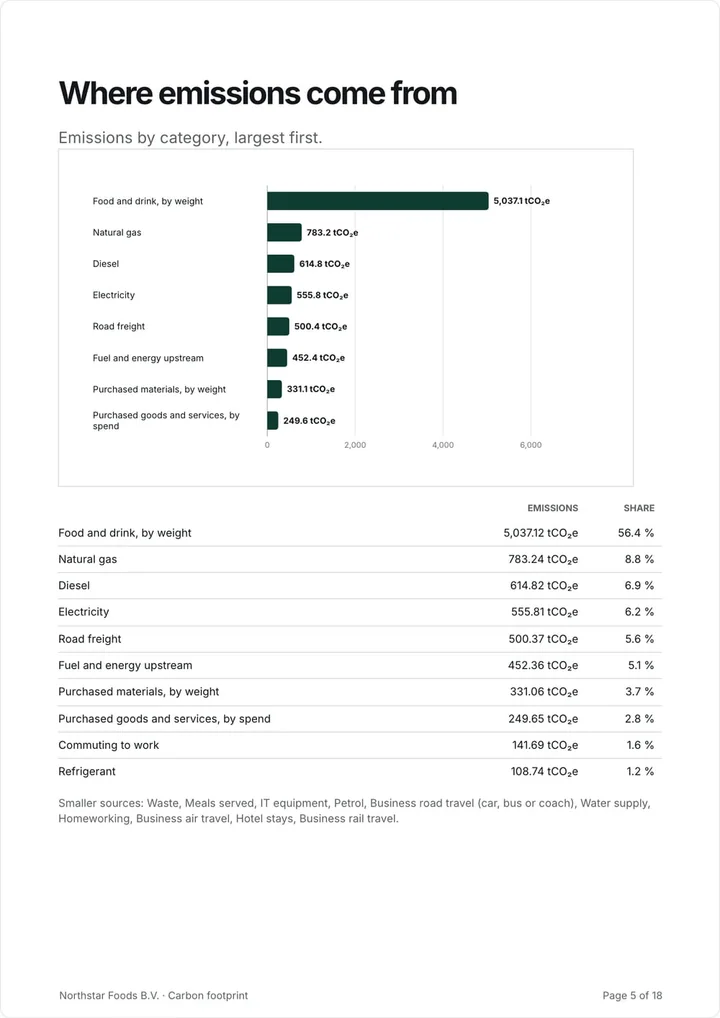
- Climate change: the sources of direct greenhouse gas emissions from fixed and mobile sources, known as Scope 1, and the volume of those emissions where the company has that information.
- The BEGES or the simplified greenhouse gas report, for companies that must prepare one.
Larger companies and group figures
Companies with 300 employees or more that publish a non-financial statement use the environmental information from that statement, together with their greenhouse gas report. When the figures are not produced for the company itself, for example only for the group or for each site, they must come with the extra information needed to read them at company level.
Which years it covers
The information covers the current year and the two previous years and, as far as they can be foreseen, the next three years: as figures, or as broad trends for the years ahead. The employer keeps the database up to date and makes it available to the members of the CSE and to union representatives. Failing to provide it can be treated as obstructing the committee, which carries a fine of €7,500.
Scope 1 in practice
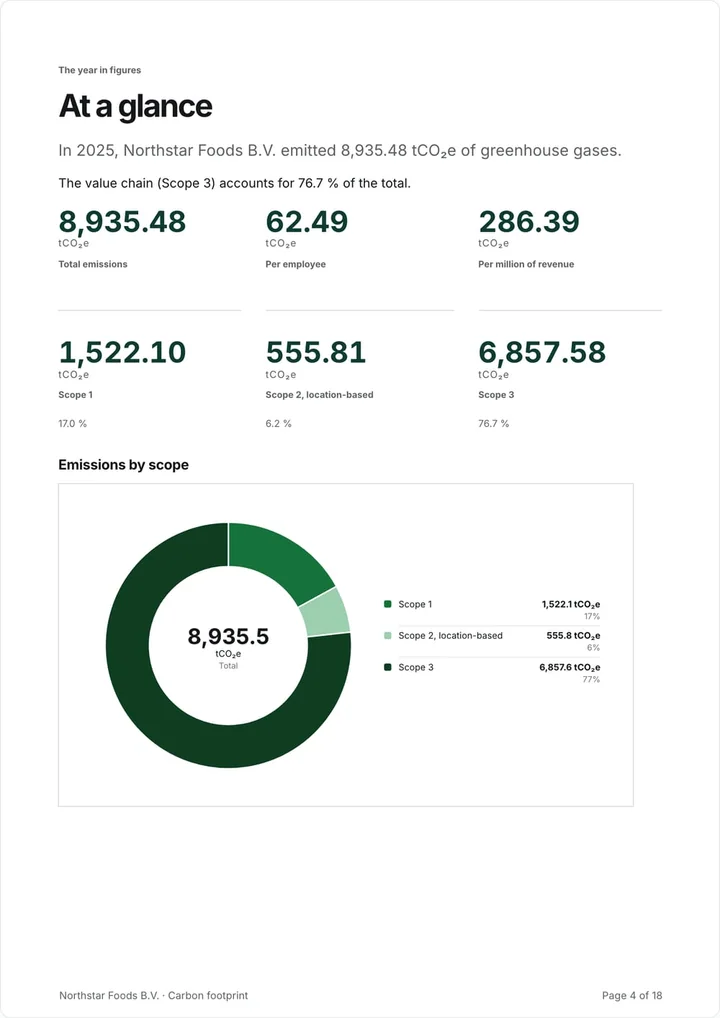
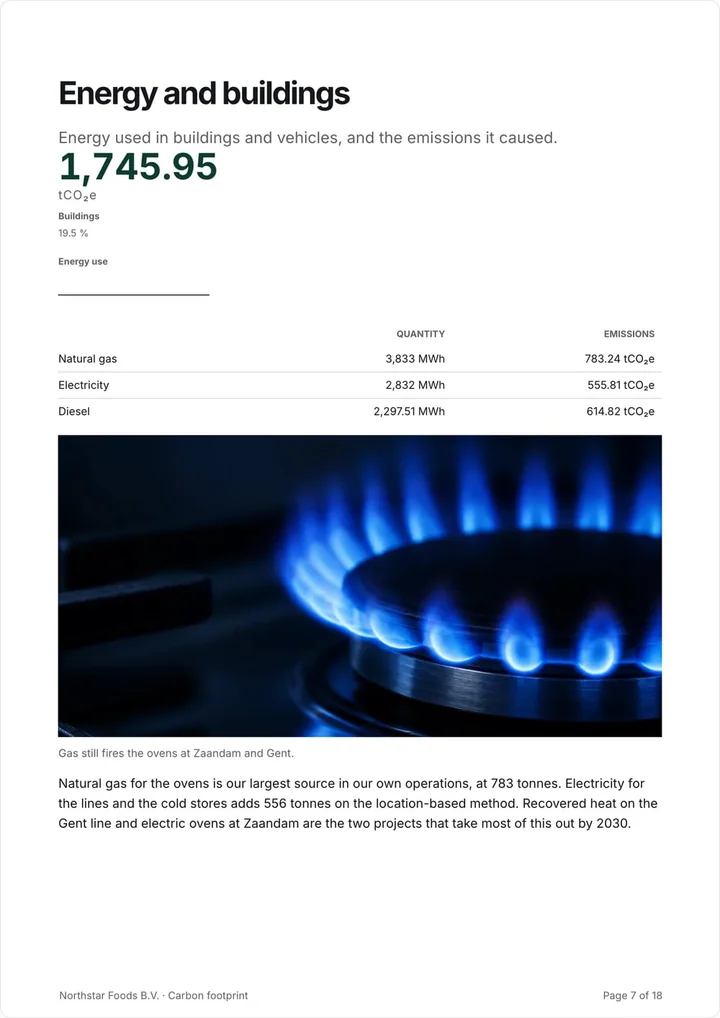
Scope 1 is the fuel the company burns itself: gas or heating oil in boilers and ovens (fixed sources), and diesel and petrol in company vehicles and machines (mobile sources). To evaluate the volume, multiply each quantity, in litres, kWh or cubic metres, by a published emission factor, for example from ADEME’s Base Empreinte, and keep the invoices behind each figure. Energy consumption comes from the same invoices, so one collection covers both indicators, and the same data is the starting point for a BEGES or a full carbon footprint.
Doing it in Greener Ahead
Greener Ahead does not host your BDESE. Carbon accounting in Greener Ahead calculates your Scope 1 emissions by source, stationary and mobile combustion, from the quantities on your invoices, with the emission factor and source behind every tonne. Sustainability Reporting asks for energy, water and waste, including hazardous waste, as part of a VSME report. Carbon accounting costs €1,495 per year and Sustainability Reporting €995, both with unlimited users, and you can try them free for 14 days without a card. Check the pricing page for current details.
The environmental indicators at a glance
What to give for each indicator, and where the figure usually comes from.
| Indicator | What to give | Where the figure comes from |
|---|---|---|
| Environmental policy | How environmental questions are organised; any assessment or certification | Management, ISO 14001 or other certificates |
| Hazardous waste | Quantity with a hazardous waste tracking slip | Tracking slips, Trackdéchets |
| Water | Water consumption | Water bills, meters |
| Energy | Energy consumption | Electricity, gas and fuel invoices |
| Scope 1 | Direct emission sources, fixed and mobile, and their volume where known | Fuel and gas quantities times emission factors |
| Greenhouse gas report | BEGES or simplified report, if required | The latest report you prepared |
Preparing the section each year
Collecting the figures once a year keeps the database current and comparable.
- Check whether a company agreement changes the content, or whether the decree applies.
- Collect energy, fuel and water quantities from invoices for the full year.
- Add the hazardous waste quantities from the tracking slips.
- Calculate Scope 1 emissions with published emission factors and keep the evidence.
- Show the current year, the two previous years and the trend for the next three.
Sources and scope
- Code du travail numérique: article L2312-36 of the Labour Code
- Code du travail numérique: article R2312-8 of the Labour Code
- Code du travail numérique: article R2312-9 of the Labour Code
These resources explain a preparation workflow. Check your selected standard and recipient requirements before sharing your report.
 Joost ThissenFounder