ESG stands for environmental, social and governance: the topics banks, customers and investors use to judge a company beyond its financial accounts. Environmental covers energy, emissions, water and waste; social covers working conditions, safety, pay and human rights; governance covers policies, anti-corruption and how the company is run. The EU voluntary standard (VSME) covers all three in one report.
What ESG stands for
ESG stands for environmental, social and governance. It is the set of topics outsiders use to judge how a company handles its impact and its risks beyond the financial accounts: what it emits and consumes, how it treats people, and how it is run. The term comes from a 2004 report by the UN Global Compact and a group of banks, written to bring these topics into investment decisions.
ESG is often confused with two related words. Corporate social responsibility (CSR) describes what a company commits to on its own initiative. Sustainability is the broader goal. ESG is the measuring side: the criteria and figures that banks, customers and investors use to compare companies.
The criteria in each of the three pillars
There is no single official list, but the criteria are much the same everywhere. Most questionnaires, ratings and standards group them like this.
- Environmental: energy use, greenhouse gas emissions, pollution, water, biodiversity, raw materials and waste.
- Social: employment and working conditions, health and safety, pay and training, diversity, human rights in your own company and in the supply chain.
- Governance: policies and how they are enforced, anti-corruption and bribery, the composition of the board, business ethics and how decisions are made.
Who asks about ESG, and why
Banks ask because European supervisors require them to manage ESG risk in their loan books, so they need information from the companies they lend to. Large customers ask because they report on their value chain or have procurement policies that score suppliers. Investors ask because ESG risks affect value, and public tenders increasingly award points for it. Employees and job applicants ask too.
The questions differ in wording, but they come back to the same topics. That is why it pays to collect the figures once, with evidence, rather than answering every questionnaire from scratch.
ESG scores and ratings
An ESG rating is a score given by an outside provider. Rating agencies such as MSCI and Sustainalytics mostly rate listed companies, using public information. For suppliers, the common route is a platform such as EcoVadis, where the company submits documents and receives a scorecard. Each provider uses its own method, so the same company can score very differently from one rating to the next.
Most companies that are asked about ESG have no rating at all, and do not need one. What the reader needs is a clear set of figures and policies they can check. A report under the EU voluntary standard gives exactly that, at no licence cost.
Answering ESG questions in Greener Ahead
Sustainability reporting in Greener Ahead follows the EU voluntary standard (VSME), which covers all three pillars: energy, emissions, waste and water for environmental, workforce, safety and pay for social, and policies and anti-corruption for governance. It shows only the disclosures that apply, keeps the evidence beside every answer and turns the result into a report you can share by link. It costs €995 per year with unlimited users, and you can try it free for 14 days without a card. Check the pricing page for current details.
ESG criteria and where the VSME standard covers them
The voluntary standard was written around the same topics, so each common ESG criterion has a disclosure. B disclosures are in the Basic module, C disclosures in the Comprehensive module.
| Pillar | Criterion | VSME disclosure |
|---|---|---|
| Environmental | Energy use and greenhouse gas emissions | B3; targets in C3 |
| Environmental | Climate risks | C4 |
| Environmental | Pollution of air, water and soil | B4 |
| Environmental | Biodiversity | B5 |
| Environmental | Water | B6 |
| Environmental | Resource use and waste | B7 |
| Social | Workforce composition | B8; more in C5 |
| Social | Health and safety | B9 |
| Social | Pay, collective bargaining and training | B10 |
| Social | Human rights | C6 and C7 |
| Governance | Policies and practices | B2; more in C2 |
| Governance | Corruption and bribery | B11 |
| Governance | Gender balance of the board | C9 |
| Governance | Revenue from sensitive sectors | C8 |
The ESG questions you will see most
Whatever the wording, most questionnaires start with these. Have the answer and the document behind it ready.
- How much energy did you use last year, and how much of it was renewable?
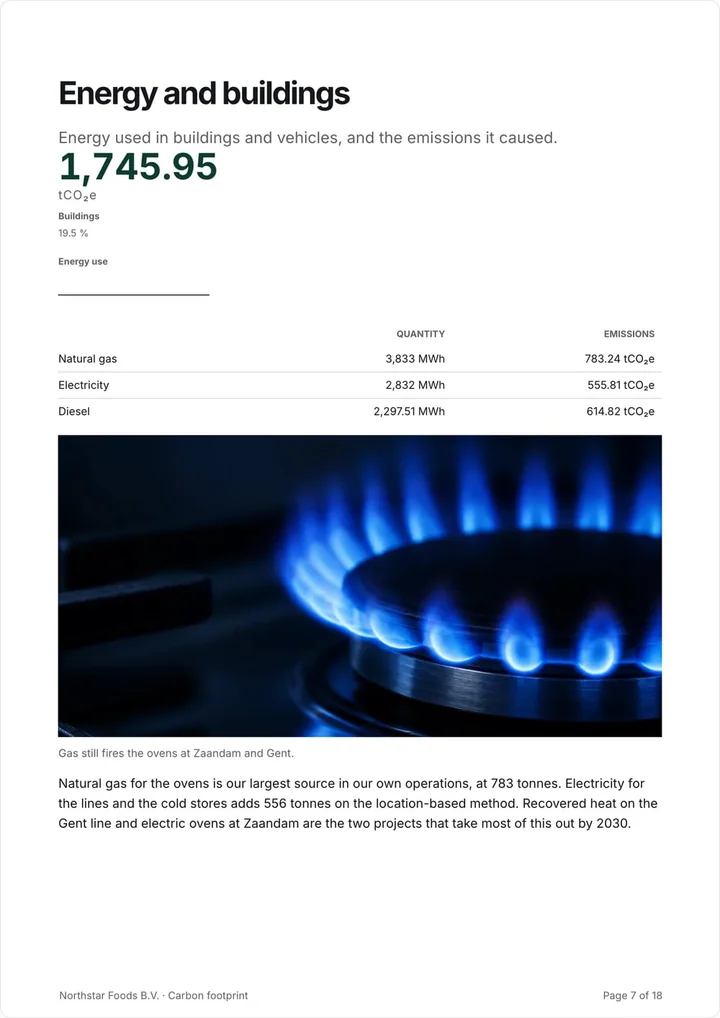
- What were your Scope 1 and 2 emissions, and do you have a reduction target?
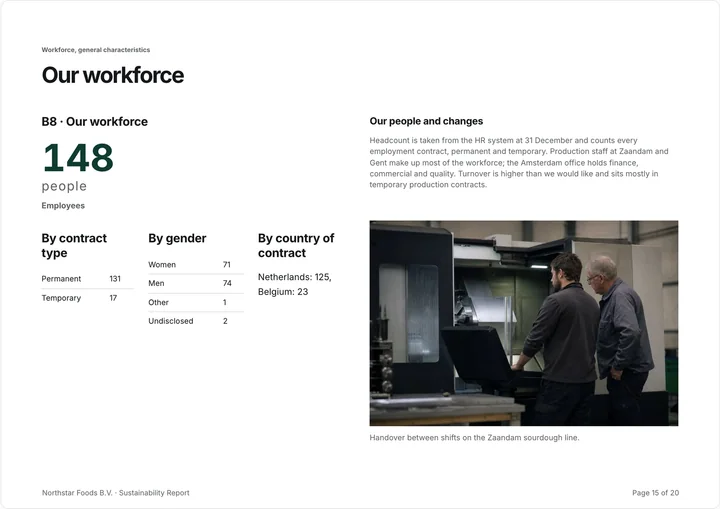
- How many people work for you, and how many work accidents were there?
- Do you have policies on the environment, human rights and anti-corruption?
- Have you been convicted or fined for corruption or bribery?
Mistakes to avoid
A reader who checks ESG answers looks for these.
- A policy that exists on paper but has no owner or date.
- Claims such as “green” or “carbon neutral” without figures behind them.
- Different answers to the same question for different customers.
- Figures for the wrong year or for only part of the company.
Sources and scope
- UN Global Compact: Who Cares Wins (2004)
- EBA: Guidelines on the management of ESG risks (EBA/GL/2025/01)
- European Commission: 2025 VSME recommendation and standard
These resources explain a preparation workflow. Check your selected standard and recipient requirements before sharing your report.
 Joost ThissenFounder