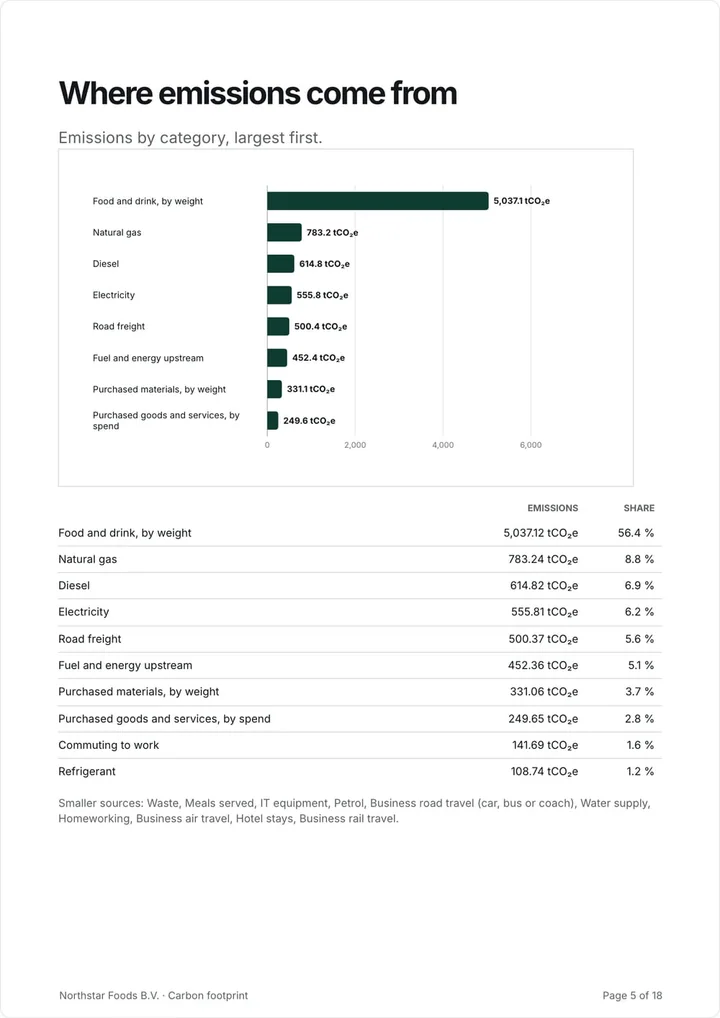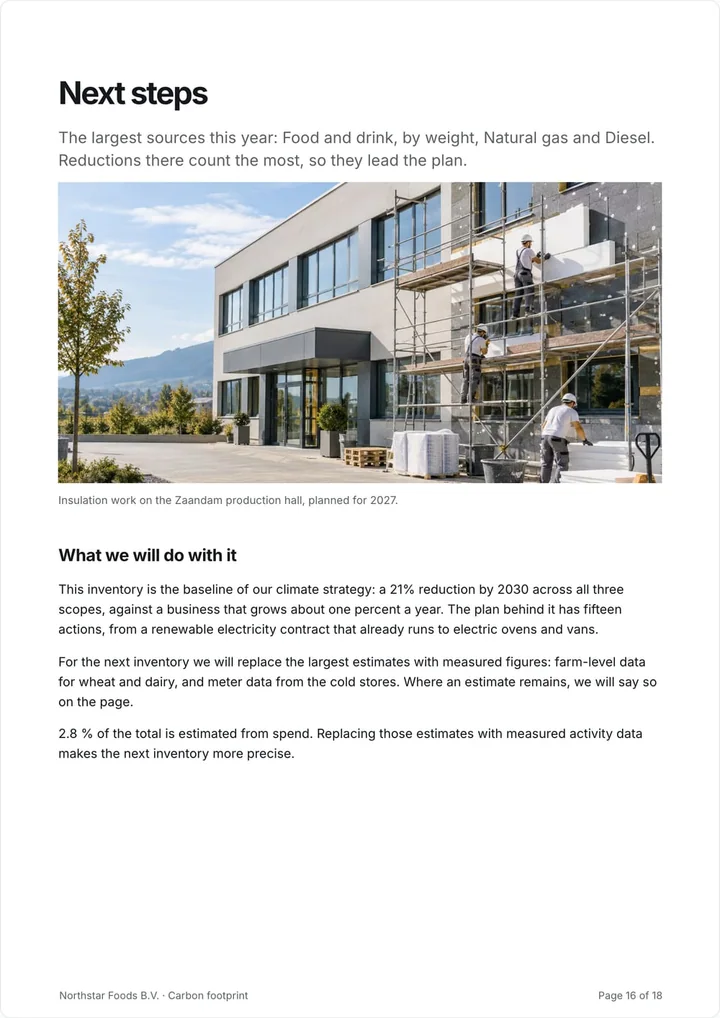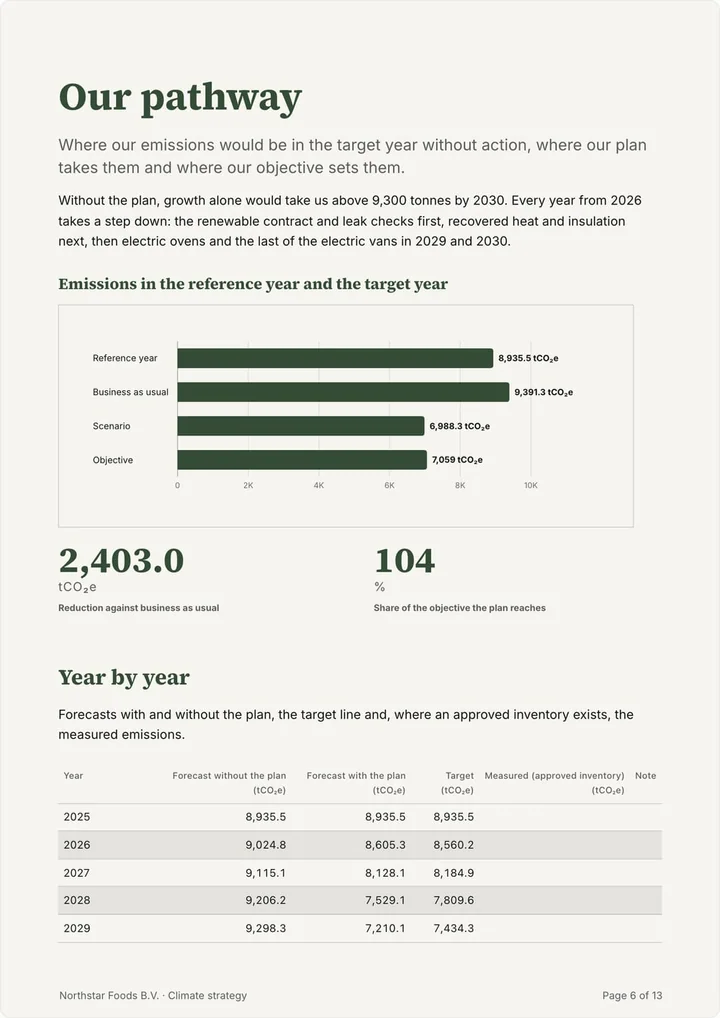
A Carbon Reduction Plan under PPN 006 is required by UK central government buyers for contracts above £5 million a year, as a condition of participation. It commits you to net zero by 2050 for UK operations and gives your baseline and current Scope 1, Scope 2 and five Scope 3 categories, your targets and your reduction measures. Publish it on your UK website, approved by the board and signed by a director, and update it every year.
When a Carbon Reduction Plan is required
Procurement Policy Note 006 tells UK central government departments, their executive agencies and non-departmental public bodies to ask bidders for a Carbon Reduction Plan (CRP). It applies to procurements under the Procurement Act 2023, which covers procurements started on or after 24 February 2025, for contracts with an estimated value above £5 million a year including VAT, averaged over the life of the contract, unless the requirement would not be relevant or proportionate. Procurements started before that date follow the earlier note, PPN 06/21, which works the same way.
The CRP is a condition of participation that tests your technical ability. A bid without a CRP that meets the standard can be excluded, however good the rest of it is. Frameworks and dynamic markets are covered when an individual contract under them is expected to exceed £5 million a year.
What goes in the plan
The government publishes a template and a technical standard. The plan is a short summary document with fixed sections.
- Your commitment to reach net zero by 2050 at the latest for your UK operations.
- Baseline emissions: the base year and the Scope 1, Scope 2 and included Scope 3 emissions for that year.
- Current emissions for the latest reporting year, in the same breakdown.
- Your emission reduction targets.
- Carbon reduction projects you have completed and the measures you will apply during the contract.
- A declaration that the plan follows the technical standard, approved by the board and signed off by a director.
How the emissions must be calculated
The footprint covers your emission sources in the United Kingdom and follows the GHG Protocol Corporate Standard, with all Scope 1 and Scope 2 emissions. It covers the seven greenhouse gases of the Kyoto Protocol, expressed in tonnes of CO₂ equivalent using the conversion factors the UK Government publishes, as the technical standard asks. You choose financial control, operational control or equity share as the boundary.
For Scope 3 you report five of the 15 categories: upstream transportation and distribution, waste generated in operations, business travel, employee commuting, and downstream transportation and distribution. Other categories may be added but are not required. There is no requirement to have the footprint audited, although ISO 14064-3 and ISAE 3410 are named as widely used verification standards.
Publishing and keeping it current
Publish the plan on your UK website, with a link in a prominent place on your homepage; without a website, you must send a copy to anyone who asks within 30 days. The plan must state that the board of directors, or equivalent management body, approved it and on which date, and it must be signed off by a director with name, job title and date. Review and update it every year, within six months of your financial year end. A company may rely on its parent’s plan only temporarily, and only if it is wholly owned, adopts the parent’s commitment in the plan, can apply the parent’s measures in the contract and publishes the plan on its own website.
Doing it in Greener Ahead
Carbon accounting in Greener Ahead calculates Scope 1, Scope 2 and all 15 Scope 3 categories, including the five a Carbon Reduction Plan asks for, with the source and evidence behind every tonne, and compares each year with your base year. It costs €1,495 per year with unlimited users, and you can try it free for 14 days without a card. Check the pricing page for current details.
The plan section by section
Each section of the template needs its own source. The last column is where the content usually comes from.
| Section | What to enter | Where it comes from |
|---|---|---|
| Commitment | Net zero by 2050 at the latest for UK operations | A board decision |
| Baseline emissions | Base year, Scope 1, Scope 2, the five Scope 3 categories, total | Your base-year footprint |
| Current emissions | The same breakdown for the latest reporting year | This year’s footprint |
| Reduction targets | Target years and reductions | Your target or decarbonisation plan |
| Reduction projects | Completed projects and measures for the contract | Your decarbonisation plan |
| Declaration and sign-off | Board approval date, director’s name, title and date | Board minutes |
Reasons a plan fails the condition of participation
Buyers check the plan against the technical standard. These are the gaps that cost bids.
- One of the five Scope 3 categories is missing or unexplained.
- No board approval date or no director sign-off.
- The plan is not published on the bidder’s own UK website.
- The plan is more than a year old, or was not updated within six months of the financial year end.
- A parent company’s plan is used without meeting the conditions for relying on it.
Sources and scope
- GOV.UK: PPN 006, taking account of Carbon Reduction Plans in the procurement of major government contracts
- GOV.UK: PPN 006 technical standard for completion of Carbon Reduction Plans
- GHG Protocol: Corporate Value Chain (Scope 3) Standard
These resources explain a preparation workflow. Check your selected standard and recipient requirements before sharing your report.
 Joost ThissenFounder