A climate risk assessment shows how climate change could harm your company: physical risks such as floods, heat and drought at your sites and suppliers, and transition risks such as carbon prices, new rules, customer demands and technology. You list what could be hit, screen each site with public hazard maps, rank the risks by likelihood and impact over time, and decide actions. Banks, the VSME Comprehensive module and the EU taxonomy ask for it.
What is a climate risk assessment?
A climate risk assessment looks at how climate change could harm a company: through the weather itself, the physical risks, and through the shift to a low-carbon economy, the transition risks. It is the other side of a carbon footprint. The footprint measures the company’s effect on the climate; the risk assessment measures the climate’s effect on the company. The categories come from the Task Force on Climate-related Financial Disclosures (TCFD), whose recommendations now continue in the ISSB’s IFRS S2 standard.
Physical risks
Physical risks come from the weather and the climate:
- Acute: floods, storms, heatwaves, wildfires and droughts that damage sites, stop production or cut supply routes.
- Chronic: rising temperatures, changing rainfall, water stress and sea level rise, which raise costs over years, for example for cooling, water and insurance.
- Indirect: the same hazards at suppliers, ports and transport routes, which reach you as late deliveries or higher prices.
Transition risks
Transition risks come from the response to climate change:
- Policy and legal: carbon pricing, energy taxes, the carbon border adjustment mechanism and stricter rules on products and green claims.
- Market: customers choosing lower-carbon suppliers, and changing energy and raw material prices.
- Technology: low-carbon alternatives that make current equipment or products less competitive.
- Reputation: being seen as lagging behind, or making climate claims you cannot back up.
Who asks for it
The European Central Bank’s guide of 2020 and the European Banking Authority’s guidelines on ESG risks of 2025 expect banks to manage climate risks in their lending, so bank questionnaires ask borrowers about the physical risks at their sites and their exposure to the transition. The EU voluntary standard (VSME) asks in its Comprehensive module whether the company has identified climate-related hazards and transition events, how exposure and sensitivity were assessed, over which time horizons, and which adaptation actions it took. The EU taxonomy requires a climate risk assessment before an activity can count as aligned.
Six steps for your company
A first assessment can be done in a few days with public data:
- List what could be hit: your sites with their addresses, your key suppliers and the transport routes you depend on.
- Screen each site for physical hazards, today and around 2050, under a lower and a higher emissions scenario.
- List the transition risks for your sector: rules, prices, customer demands and technology.
- For each risk, estimate how likely it is and how hard it would hit over short, medium and long time horizons, and rank them.
- Decide actions for the top risks, such as flood protection, a second supplier or a plan to cut energy use, and give each an owner.
- Repeat the assessment every year, and when you open a site or change key suppliers.
Free tools for physical hazards
Public tools show climate hazards and projections by address or region:
- EU: the Copernicus Climate Change Service, with climate data and projections for all of Europe.
- France: Géorisques for hazards by address, and DRIAS for climate projections.
- Germany: the climate atlas of the German Weather Service (DWD).
- Netherlands: the Klimaateffectatlas.
- Italy: IdroGEO from ISPRA, with landslide and flood hazard by address.
- Spain: the AdapteCCa climate change scenarios viewer.
- Poland: KLIMADA 2.0, with climate risk by province and county.
- United Kingdom: the government’s long term flood risk check for England.
Doing it in Greener Ahead
Greener Ahead does not run climate scenario models. Sustainability Reporting covers the VSME climate risk disclosures in the Comprehensive module: the hazards and transition events you identified, how exposure and sensitivity were assessed, the time horizons and your adaptation actions, next to each site’s address and location. Carbon accounting measures the emissions behind your transition risk, such as the energy use exposed to carbon prices. Sustainability Reporting costs €995 per year and Carbon accounting €1,495, both with unlimited users, and you can try them free for 14 days without a card. Check the pricing page for current details.
A simple risk register
Examples of how a manufacturer might record its first risks.
| Risk | Type | Time horizon | Action |
|---|---|---|---|
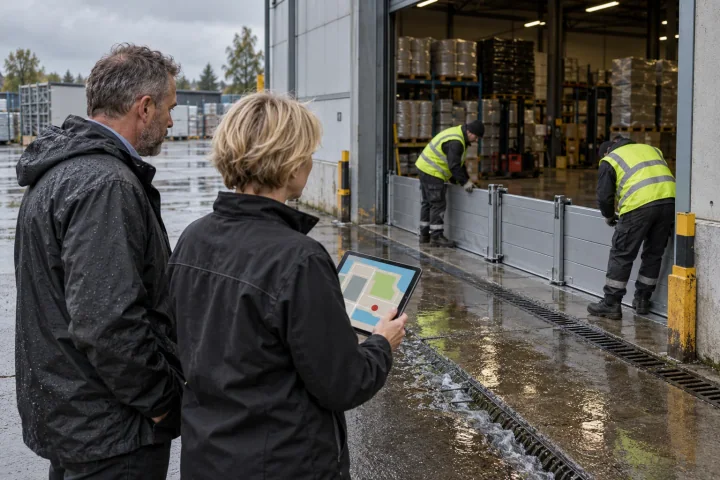
| River flooding at the main plant | Physical, acute | Medium | Flood barriers and raised storage for stock |
| Summer heat in the production hall | Physical, chronic | Long | Shading, ventilation and adjusted shifts |
| Drought at a key raw material supplier | Physical, indirect | Medium | A second supplier in another region |
| Rising carbon and energy prices | Transition, policy | Short | Energy efficiency plan and on-site solar |
| Customers asking for lower-carbon products | Transition, market | Medium | Product footprints and a reduction target |
Making the assessment useful
A few habits turn a one-off exercise into a management tool.
- Use the same scenarios and time horizons every year.
- Record the source and date of every hazard map you use.
- Involve operations, purchasing and finance, not only the sustainability lead.
- Link each top risk to an action with an owner and a date.
- Reuse the same assessment for the bank, the VSME and customers.
Sources and scope
- European Commission: 2025 VSME recommendation and standard
- European Central Bank: guide on climate-related and environmental risks (2020)
- European Banking Authority: guidelines on the management of ESG risks
- Copernicus Climate Change Service
These resources explain a preparation workflow. Check your selected standard and recipient requirements before sharing your report.
 Joost ThissenFounder