A climate transition plan sets out how a company will adapt its business to a low-carbon economy: its ambition and targets, the actions and investment to get there, how it works with suppliers and customers, the metrics it tracks and who is responsible. Large companies reporting under the ESRS disclose one; the EU voluntary standard asks companies in high-impact sectors without a plan whether and when they will adopt one.
What a transition plan is
A climate transition plan sets out how a company will change its business to fit a low-carbon economy: where it wants to be, what it will do to get there, what that costs and who is responsible. It covers more than cutting emissions. It also describes how products, investments, suppliers and the business model will change, and how the company deals with the risks and opportunities of the transition.
It builds on two things you may already have. A reduction target says how far and by when. A decarbonisation plan lists the measures that cut emissions. The transition plan puts both into the company’s strategy, with money, governance and a way to track progress.
What goes in a transition plan
The frameworks differ in detail but ask for the same core. The Transition Plan Taskforce framework, whose materials are now held by the IFRS Foundation, groups it into five elements.
- Foundations: your ambition and how it relates to your strategy, including your targets.
- Implementation: the actions in your operations, products and services, and what they mean for your finances, including planned investment.
- Engagement: how you work with suppliers, customers, peers and government to reach the ambition.
- Metrics and targets: the figures you use to steer and show progress, starting with your emissions by scope.
- Governance: who approves the plan, who is responsible for it, and how it is built into decisions and incentives.
Who has to publish one
Large companies reporting under the European Sustainability Reporting Standards (ESRS) disclose their transition plan for climate change mitigation, or state that they do not have one. Banks and investors ask for transition plans as part of managing their own climate risk, and listed companies in several countries are expected to disclose them.
The EU voluntary standard (VSME) does not require a plan. In its Comprehensive module, a company in a high climate impact sector that has adopted a transition plan may describe it, and one that has not must say whether, and if so when, it will adopt one. High climate impact sectors are NACE sections A to H and M: from agriculture, mining, manufacturing, energy, water and waste, construction, trade and transport to professional, scientific and technical activities.
How to write one
For most companies the order is the same.
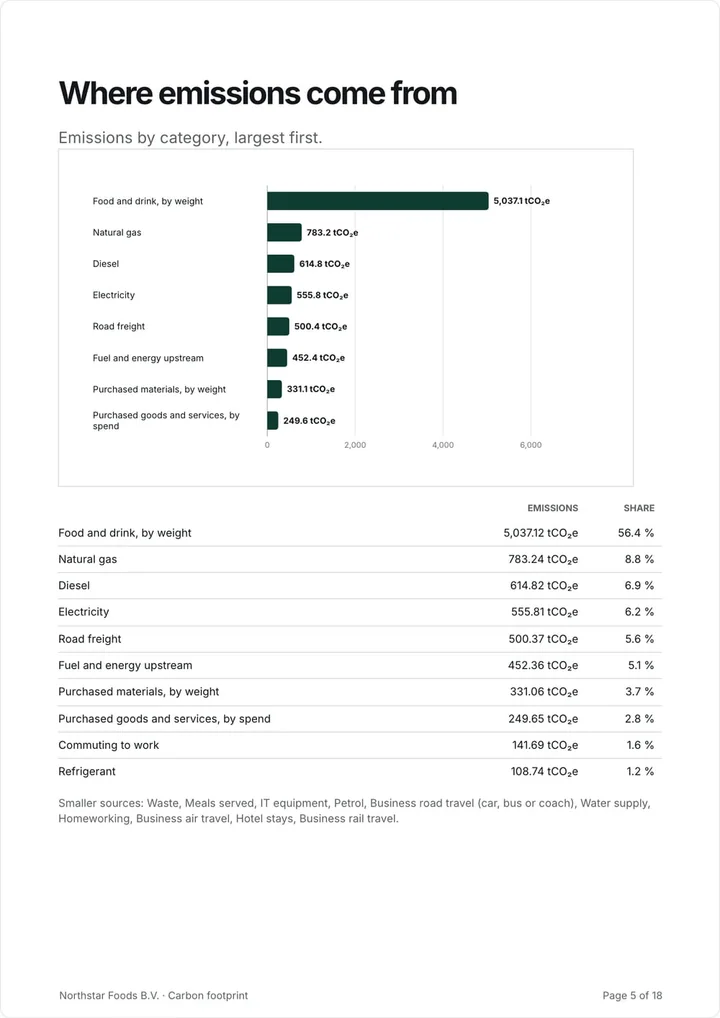
- Start from a complete footprint for a base year, so the plan addresses your real emission sources.
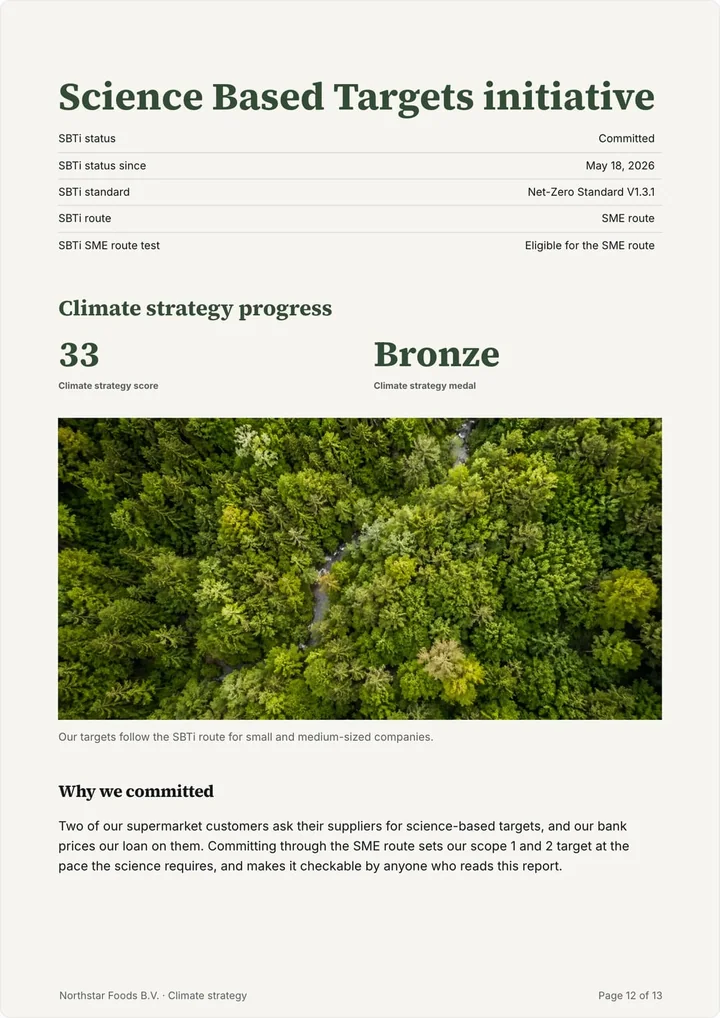
- Set a target for Scope 1 and 2, and decide how you will treat Scope 3.
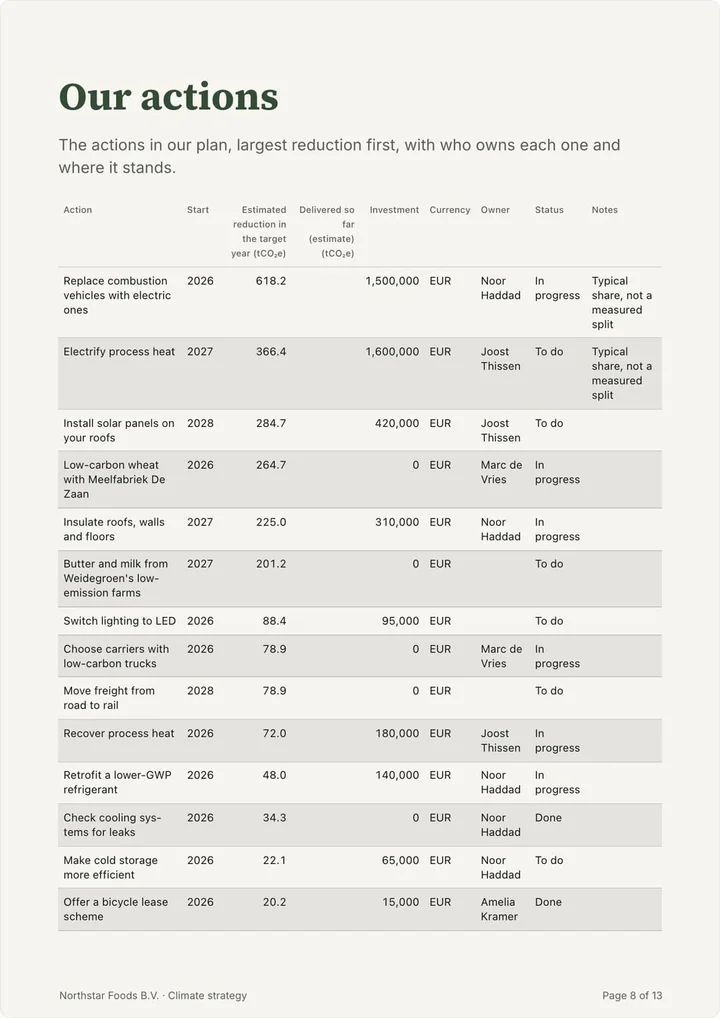
- List the measures per source with their expected reduction, cost and timing, and check that together they reach the target.
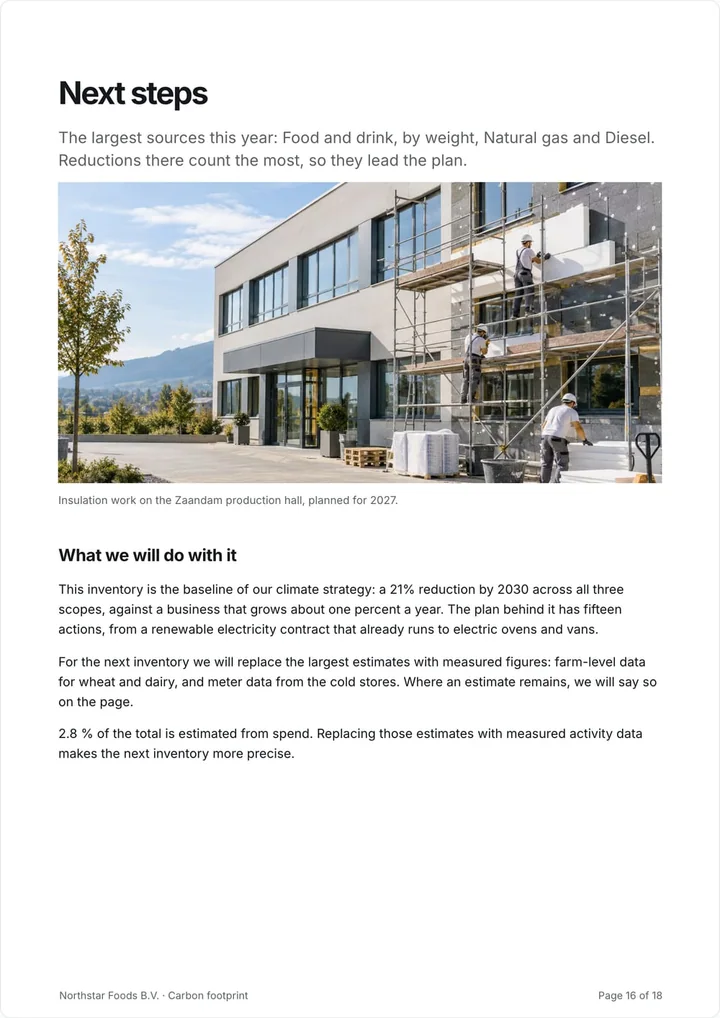
- Add what changes in the business: products, investment, suppliers and the risks you need to manage.
- Name the owner of each part, have the plan approved by management, and decide how you will report progress each year.
Doing it in Greener Ahead
Carbon accounting in Greener Ahead gives you the base-year footprint for Scope 1, 2 and all 15 Scope 3 categories that a transition plan starts from, and compares every year with the base year. It costs €1,495 per year with unlimited users, and you can try it free for 14 days without a card. Climate strategy, coming soon, adds reduction targets, an action plan and a transition plan built on that footprint. Check the pricing page for current details.
Target, decarbonisation plan and transition plan compared
The three build on each other. Most companies write them in this order.
| Reduction target | Decarbonisation plan | Transition plan | |
|---|---|---|---|
| Answers | How far, and by when? | Which measures cut which emissions? | How does the business change to get there? |
| Contains | Base year, target year, scopes covered, reduction | Measures per source with reduction, cost, timing and owner | Target and measures, plus investment, products, suppliers, risks and governance |
| Approved by | Management | The people who own the measures | Management or the board |
| Asked for by | Customers, banks, the VSME (if you have one) | Usually internal | ESRS, banks and investors, the VSME for high-impact sectors |
Signs a plan will not convince a reader
Banks and customers who read transition plans look for these gaps first.
- A target with no measures, or measures that do not add up to the target.
- No money: no investment figures and no link to the budget.
- Offsets presented as reductions.
- No owner, no approval date and no progress report.
- Scope 3 left out without explanation when it is most of the footprint.
Sources and scope
- European Commission: 2025 VSME recommendation and standard
- EFRAG: VSME supporting guide on disclosure C3, GHG reduction targets and climate transition
- IFRS Foundation: Transition Plan Taskforce resources
These resources explain a preparation workflow. Check your selected standard and recipient requirements before sharing your report.
 Joost ThissenFounder