The EU taxonomy is the EU’s list of economic activities that count as environmentally sustainable, with technical criteria for each. An activity is aligned when it contributes substantially to one of six environmental objectives, does no significant harm to the others, and the company meets minimum safeguards. Since 2026 only companies with more than 1,000 employees and €450 million turnover must report it, but banks and customers still ask other companies about specific investments.
What is the EU taxonomy?
The EU taxonomy is the EU’s classification of environmentally sustainable economic activities, set up by the Taxonomy Regulation (EU) 2020/852. It lists activities, such as renovating buildings, generating solar power or making cement, and for each sets technical screening criteria that say when the activity counts as sustainable. It judges activities, not companies: a company reports what share of its turnover, capital expenditure (CapEx) and operating expenditure (OpEx) comes from activities that meet the criteria.
The six environmental objectives
Every activity is assessed against six objectives:
- Climate change mitigation.
- Climate change adaptation.
- Sustainable use and protection of water and marine resources.
- Transition to a circular economy.
- Pollution prevention and control.
- Protection and restoration of biodiversity and ecosystems.
Eligible and aligned
An activity is eligible when it is described in one of the delegated acts, mainly the Climate Delegated Act (EU) 2021/2139 and the Environmental Delegated Act (EU) 2023/2486. It is aligned when it also passes three tests:
- It contributes substantially to one objective, as defined by the technical screening criteria for that activity.
- It does no significant harm to the other five objectives, which includes a climate risk assessment for the activity.
- The company meets minimum safeguards on human rights, bribery, taxation and fair competition.
Who has to report it
Since Directive (EU) 2026/470, taxonomy reporting under the CSRD applies only to companies with more than 1,000 employees and more than €450 million turnover; others may report voluntarily. A separate delegated act simplified the reporting templates from 2026 and lets companies leave out activities that make up less than 10% of their turnover, CapEx or OpEx. Large banks disclose a green asset ratio, the share of their assets that finance aligned activities, and bonds under the EU Green Bond Standard must use their proceeds mainly for aligned activities.
Why companies outside the rules are asked
Most companies never have to report taxonomy figures, but the questions reach them through lenders and customers. A bank financing a renovation, solar panels or a heat pump may ask whether the investment meets the taxonomy criteria, so that it can count the loan as green. A large customer that reports taxonomy figures can count some purchases as aligned CapEx, such as a renovation or the installation of energy efficiency equipment, so it may ask the supplier who did the work for evidence that it meets the criteria. The Commission’s Recommendation (EU) 2023/1425 encourages companies, including SMEs, to use the taxonomy voluntarily, for example to show that a single investment is aligned even when the company as a whole does not report.
A worked example: renovating your building
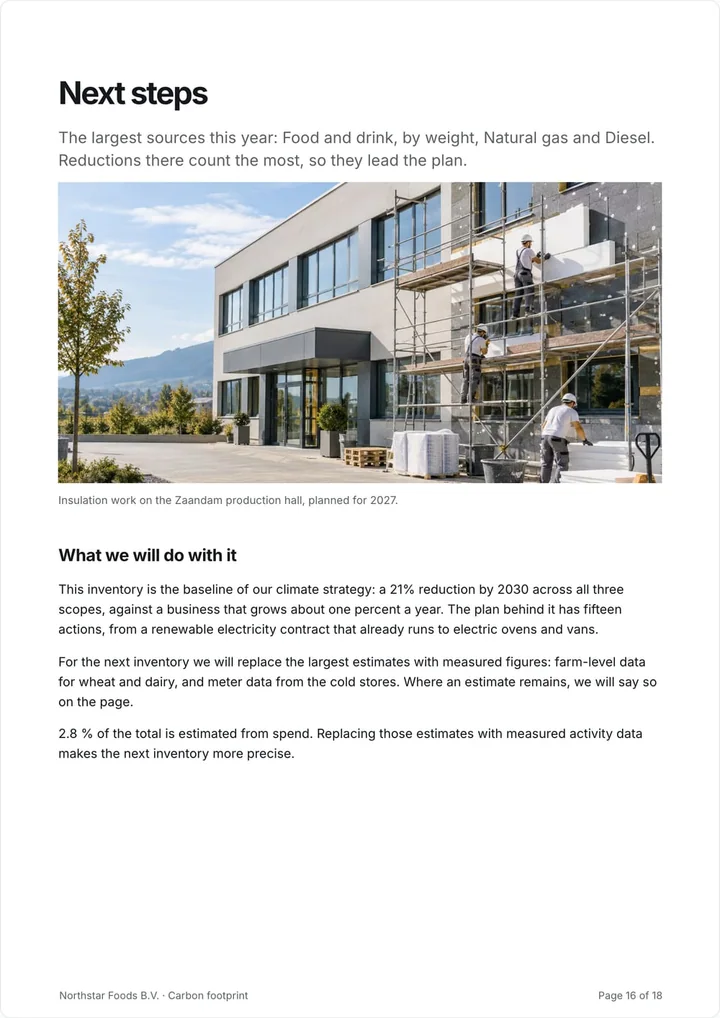
A company renovating its offices applies for a green loan. The taxonomy activity is 7.2, renovation of existing buildings. The main criterion is that the renovation cuts the building’s primary energy demand by at least 30%, shown by an energy assessment before and after the works. The bank will also look at the do no significant harm criteria, such as a climate risk assessment for the building and at least 70% of non-hazardous construction and demolition waste prepared for reuse or recycling. Keep these documents with the investment, because the bank may ask for them again when it reviews the loan.
Doing it in Greener Ahead
Greener Ahead does not assess taxonomy alignment. Carbon accounting in Greener Ahead gives you the energy and emissions figures behind a green loan application or a customer request: your footprint by scope and year, with the emission factor and source behind every tonne. Sustainability Reporting prepares a VSME report, the EU voluntary standard that banks and customers can ask companies outside the reporting rules for. Carbon accounting costs €1,495 per year and Sustainability Reporting €995, both with unlimited users, and you can try them free for 14 days without a card. Check the pricing page for current details.
Activities companies are most often asked about
The activities behind most green loan and customer questions, with the question that usually comes with them.
| Activity | Number | Typical question |
|---|---|---|
| Renovation of existing buildings | 7.2 | Does the renovation cut primary energy demand by at least 30%? |
| Installation of energy efficiency equipment | 7.3 | Which measures, and do they meet the listed requirements? |
| Renewable energy technologies on buildings | 7.6 | Which solar panels, heat pumps or batteries were installed? |
| Electricity generation using solar photovoltaic technology | 4.1 | Has a climate risk assessment been done for the installation? |
| Acquisition and ownership of buildings | 7.7 | What is the building’s energy performance certificate? |
Before you answer a taxonomy question
Answer about the investment, with evidence, rather than about the company in general.
- Find the taxonomy activity that matches the investment.
- Read its substantial contribution criterion and collect the evidence.
- Check the do no significant harm criteria, including a climate risk assessment.
- Keep the evidence with the investment, not only in the answer.
- Say clearly when an investment is eligible but not shown to be aligned.
Sources and scope
- EUR-Lex: Regulation (EU) 2020/852, the Taxonomy Regulation
- EUR-Lex: Climate Delegated Act (EU) 2021/2139
- EUR-Lex: Commission Recommendation (EU) 2023/1425 on facilitating finance for the transition
- European Commission: EU taxonomy navigator
These resources explain a preparation workflow. Check your selected standard and recipient requirements before sharing your report.
 Joost ThissenFounder