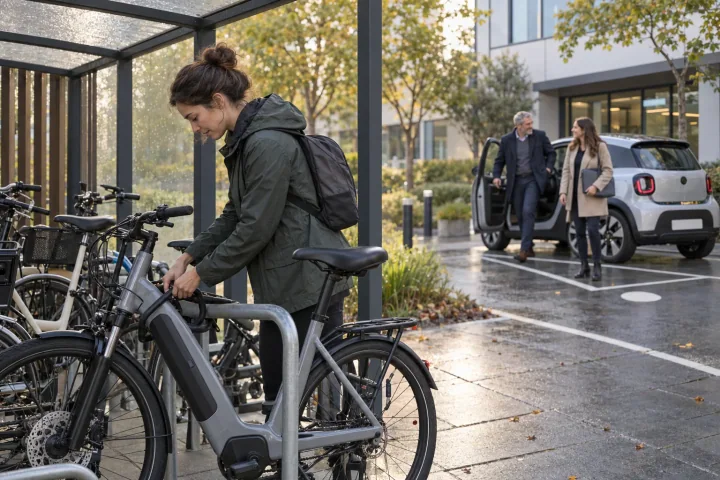
The forfait mobilités durables is an optional allowance a French employer can pay towards commuting by bike, carpooling, shared mobility, personal electric scooters or public transport tickets. In 2026 it is free of social contributions and income tax up to €600 per employee per year, or €900 together with the contribution to a public transport pass. The employer sets it up by agreement, or by a unilateral decision after consulting the CSE.
What is the forfait mobilités durables?
The forfait mobilités durables (FMD) lets a French employer pay part or all of what employees spend commuting by sustainable modes, free of social contributions and income tax up to a limit. The Mobility Orientation Law of 24 December 2019 created it, and article L3261-3-1 of the Labour Code sets it out. It is optional for private employers, unlike the contribution to public transport passes, which is mandatory at half the price.
Which journeys it covers
The allowance covers journeys between home and work made:
- By personal bike, including an electric bike.
- By carpooling, as driver or passenger.
- With shared mobility services, such as self-service bikes and scooters, or car sharing with low-emission vehicles.
- With personal motorised devices, such as electric scooters.
- By public transport with tickets other than season tickets, which the mandatory contribution already covers.
How much is exempt in 2026
The allowance is free of social contributions and income tax up to €600 per employee per year. When the employer also pays part of a public transport pass, the two together are exempt up to €900 a year. When the employer also pays a fuel or charging allowance (prime transport), the two together stay within €600, of which at most €300 for fuel. The employer can pay it on the payslip or through a prepaid titre-mobilité card. Finance laws change these limits, so check them each year.
How to set it up
An employer sets up the allowance by company agreement or branch agreement, or by a unilateral decision after consulting the social and economic committee (CSE). It must apply on the same terms to all employees in the same situation, and the employer can ask for proof of the journeys, such as a sworn statement or proof of payment.
Mobility in the annual negotiation
Companies with at least 50 employees on the same site must include commuting in their mandatory annual negotiation: measures to cut commuting costs and encourage cleaner modes, including the allowance. Without an agreement, they must draw up an employer mobility plan (plan de mobilité employeur) that analyses how employees travel and sets actions, a budget and a timetable.
Measuring commuting
The allowance is meant to change how people travel, so measuring commuting shows whether it works. A short survey of how far employees travel, by which mode and on how many days a week gives the emissions of commuting, Scope 3 category 7 under the GHG Protocol. Running it each year with the same questions shows whether car journeys fall, and the same figures serve the employer mobility plan and your carbon footprint.
Doing it in Greener Ahead
Greener Ahead does not pay or manage the allowance. Carbon accounting in Greener Ahead measures commuting and business travel as part of your footprint: employees answer a short commuting survey without an account, and the result shows kilometres and emissions by mode of transport, year on year. It costs €1,495 per year with unlimited users, and you can try it free for 14 days without a card. Check the pricing page for current details.
The allowance at a glance
The main rules for private employers in 2026.
| Rule | What it means |
|---|---|
| Obligation | Optional for private employers |
| Modes | Bike, carpooling, shared mobility, personal motorised devices, public transport tickets other than season tickets |
| Exempt limit | €600 per employee per year |
| With a public transport pass | €900 together |
| With a fuel allowance | €600 together, at most €300 for fuel |
| Set-up | Agreement, or unilateral decision after consulting the CSE |
| Payment | On the payslip or by titre-mobilité card |
Before you introduce it
A baseline makes the effect visible a year later.
- Survey how employees travel today, by mode, distance and days a week.
- Choose the modes and the amount, within the exempt limit.
- Consult the CSE or negotiate an agreement.
- Decide what proof employees give, such as a sworn statement.
- Run the same survey a year later to see whether car journeys fell.
Sources and scope
- Service-Public Entreprendre: forfait mobilités durables (FMD)
- Code du travail numérique: article L3261-3-1 of the Labour Code
- Code du travail numérique: article L2242-17 of the Labour Code
These resources explain a preparation workflow. Check your selected standard and recipient requirements before sharing your report.
 Joost ThissenFounder