The GHG Protocol is the standard almost every carbon footprint is calculated under. It splits emissions into Scope 1 (your own fuel and processes), Scope 2 (purchased electricity and heat) and Scope 3 (the rest of your value chain), covers seven greenhouse gases, asks you to choose an equity-share or control boundary, and sets five principles: relevance, completeness, consistency, transparency and accuracy.
What the GHG Protocol is
The Greenhouse Gas Protocol is the most widely used set of standards for measuring and reporting greenhouse gas emissions. It was developed by the World Resources Institute (WRI) and the World Business Council for Sustainable Development (WBCSD), and its Corporate Standard was first published in 2001 and revised in 2004. When a bank, a customer or a reporting standard asks for your carbon footprint, it almost always means a footprint calculated under the GHG Protocol.
The protocol does not give you emission factors and is not a certification. It sets the rules: which emissions to count, how to group them, where to draw the boundary of your company and how to report the result. The emission factors come from published national and international sources, and the GHG Protocol is currently being revised; until new versions are published, the existing standards apply.
Scope 1, 2 and 3
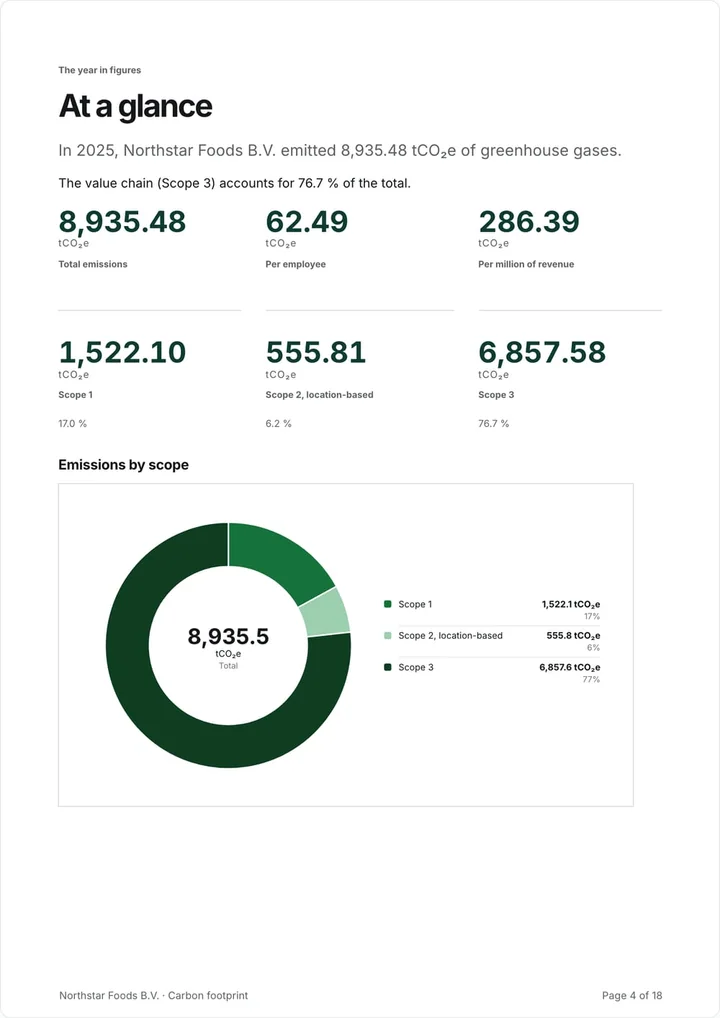
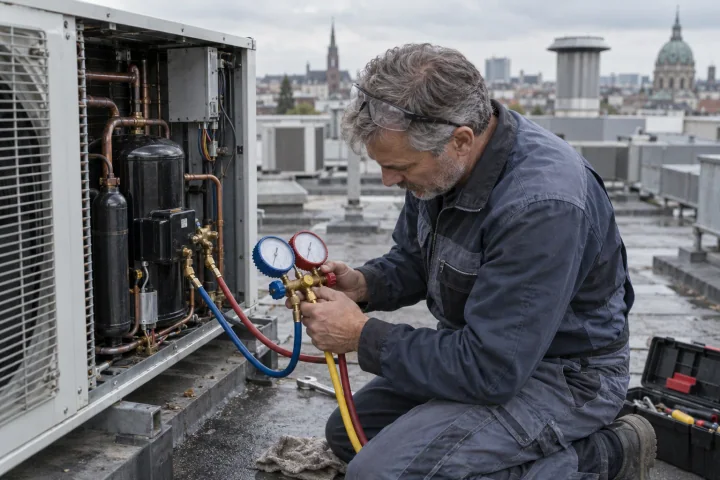
The best-known part of the protocol is the split into three scopes. Scope 1 covers direct emissions from sources you own or control: fuel burned in boilers and vehicles, process emissions and refrigerant leaks. Scope 2 covers the electricity, steam, heat and cooling you buy. Scope 3 covers all other emissions in your value chain, split into 15 categories, from purchased goods and transport to business travel and the use of the products you sell.
Scope 1 and 2 are required in every GHG Protocol inventory. Scope 3 is described in its own standard and is increasingly expected, because for most companies it is the largest part of the footprint.
The gases and the boundary
The protocol covers the seven greenhouse gases of the Kyoto Protocol: carbon dioxide, methane, nitrous oxide, hydrofluorocarbons, perfluorocarbons, sulphur hexafluoride and nitrogen trifluoride. Each is converted to CO₂ equivalent using its global warming potential, so the footprint can be given in one number.
Before calculating, you choose how to draw the boundary of your company. Under the equity share approach you count emissions in proportion to your ownership. Under the control approaches you count 100% of the operations you control, financially or operationally. Most companies use operational control, and they keep the same approach every year.
Five principles a footprint has to meet
The Corporate Standard asks every inventory to follow five principles. They are also the questions an auditor or a careful customer will ask.
- Relevance: the inventory reflects the company’s emissions and serves the people who use it.
- Completeness: every source within the boundary is included, and any exclusion is explained.
- Consistency: methods stay the same from year to year, and changes are documented.
- Transparency: assumptions, methods and sources are disclosed so others can follow them.
- Accuracy: figures are neither systematically too high nor too low, and uncertainty is reduced where possible.
Doing it in Greener Ahead
Carbon accounting in Greener Ahead follows the GHG Protocol: Scope 1, Scope 2 location-based and market-based, and all 15 Scope 3 categories, with the emission factor, source and edition behind every tonne. It costs €1,495 per year with unlimited users, and you can try it free for 14 days without a card. Check the pricing page for current details.
The standards that make up the GHG Protocol
A company footprint mainly uses the first three. The product standard is for the footprint of a single product.
| Standard | What it covers | When you need it |
|---|---|---|
| Corporate Standard | Boundaries, Scope 1 and 2, reporting rules | Every company footprint |
| Scope 2 Guidance | Location-based and market-based electricity figures | When you buy electricity, heat or steam |
| Corporate Value Chain (Scope 3) Standard | The 15 Scope 3 categories and how to calculate them | When you report your value chain |
| Product Life Cycle Standard | Emissions of one product over its life | When a customer asks for a product footprint |
Choices to write down before you calculate
The consistency principle means these choices hold from year to year. Record them once, with the reason.
- The boundary approach: operational control, financial control or equity share.
- The legal entities and sites included.
- The base year, and when you would recalculate it.
- The Scope 3 categories included, and why others are left out.
- The sources of your emission factors, with their edition.
Sources and scope
- GHG Protocol: Corporate Accounting and Reporting Standard
- GHG Protocol: Scope 2 Guidance
- GHG Protocol: Corporate Value Chain (Scope 3) Standard
- GHG Protocol: Product Life Cycle Standard
These resources explain a preparation workflow. Check your selected standard and recipient requirements before sharing your report.
 Joost ThissenFounder