From today, 12 August 2026, the EU's Packaging and Packaging Waste Regulation (PPWR), Regulation (EU) 2025/40, applies in every member state. It replaces the Packaging Directive of 1994, which is repealed from the same day apart from a few provisions that run on for a transition period. Because it is a regulation, the core rules are now the same everywhere, instead of 27 national versions of a directive.
That does not mean every rule starts today. The regulation has one start date and a long list of later ones. Here is what applies now and what is coming.
What applies from 12 August 2026
- PFAS in food-contact packaging. Food-contact packaging may no longer be placed on the market if it contains PFAS at or above 25 ppb for any single PFAS, 250 ppb for the sum of PFAS, or 50 ppm total fluorine. This is the rule with the most immediate effect on paper and board food packaging.
- Heavy metals. Lead, cadmium, mercury and hexavalent chromium together may not exceed 100 mg/kg in packaging or its components.
- Conformity. Manufacturers must carry out a conformity assessment, draw up technical documentation and an EU declaration of conformity for each packaging type, and keep them for 5 years after single-use packaging is placed on the market, or 10 years for reusable packaging.
- Extended producer responsibility. Producers have extended producer responsibility for the packaging they make available for the first time in a member state, and must register in each member state where they do so once its national register is set up. A producer that supplies a member state where it is not established has to appoint an authorised representative there.
What comes later
| Obligation | Applies from |
|---|---|
| Harmonised label on material composition, to help consumers sort | 12 August 2028, or 24 months after the implementing act, whichever is later |
| Reusable packaging carries a reuse label | 12 February 2029, or 30 months after the implementing act |
| Packaging weight and volume reduced to the minimum needed for its function | 1 January 2030 |
| Packaging must be recyclable, grades A to C | 1 January 2030, or 24 months after the delegated acts |
| Minimum recycled content in plastic packaging, for example 30% for PET contact-sensitive packaging and 35% for most other plastic packaging | 1 January 2030, or 3 years after the implementing act |
| Empty space in grouped, transport and e-commerce packaging at most 50% | 1 January 2030, or 3 years after the implementing act |
| Bans on certain single-use formats | 1 January 2030 |
| Reuse targets, for example for transport packaging, must be demonstrated | 1 January 2030, or 18 months after the implementing act |
| Recyclable at grades A or B only | 1 January 2038 |
The format bans in Annex V include single-use plastic grouping film around cans and bottles, single-use plastic packaging for less than 1.5 kg of fresh fruit and vegetables, single-use plastic packaging for food and drink consumed on the premises in cafés and restaurants, single-portion plastic sachets for sauces and sugar there, and miniature toiletries in hotels.
Many of these dates read "or a set period after the Commission adopts the act that fills in the detail, whichever is later". Until those acts exist, the later dates are a floor, not a fixed day.
Who has to act
The obligations follow the role you play, not the size of the company. Manufacturers carry the design, substance and conformity rules. Companies that fill grouped, transport or e-commerce packaging carry the empty space rule. Producers, which includes importers and online sellers that put packaged goods on a national market for the first time, carry extended producer responsibility. Distributors have to check, with due care, that what they sell complies.
For most companies, the practical work this year is an inventory: which packaging types you place on the market, in which countries, made from what, in what weight, and who your suppliers are. The same inventory feeds the recyclability and recycled content checks in 2030, and packaging waste figures in sustainability reports.
Where it meets your sustainability reporting
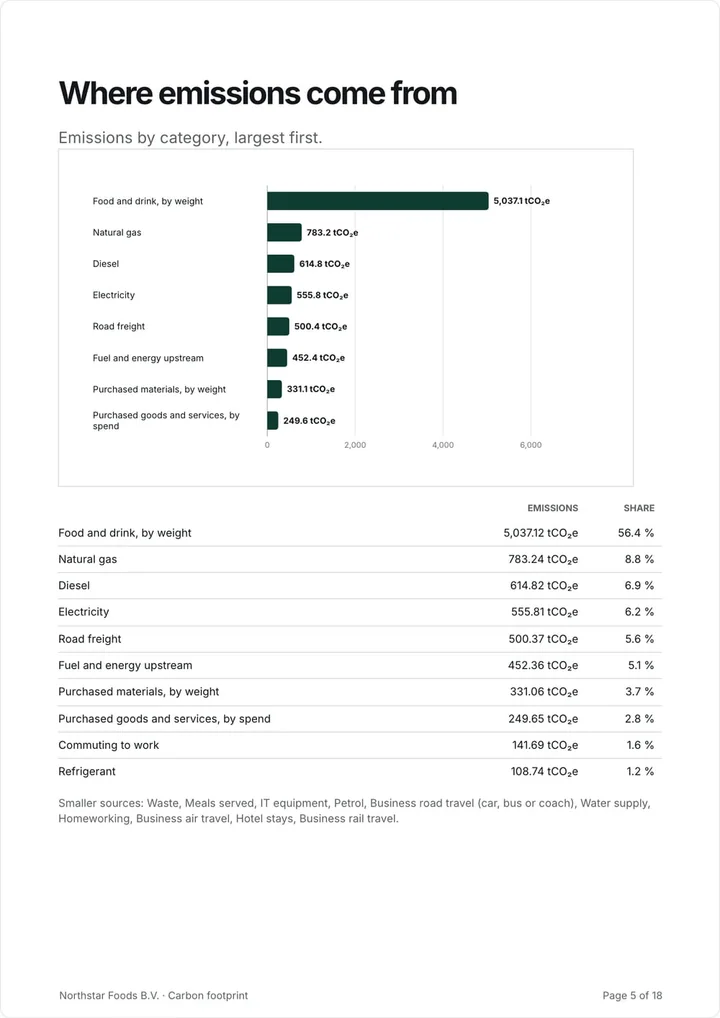
Packaging shows up in a carbon footprint twice: in purchased goods, when you buy it, and in end-of-life treatment of sold products, when your customers throw it away. Both are calculated from tonnes by material, which is exactly the data the regulation makes you collect. Greener Ahead's carbon accounting takes purchased materials and waste by weight and material, so the packaging inventory does double duty. For the reporting side, see our guides to the 15 Scope 3 categories and the voluntary sustainability standard (VSME).
 Joost Thissen