From Sunday, 27 September 2026, the EU's new rules on green claims apply. Directive (EU) 2024/825, known as EmpCo, bans vague environmental claims, claims of climate neutrality based on offsetting, and sustainability labels that nobody checks independently. Member states had to put it into national law by 27 March 2026.
Not all of them did. On 28 May 2026 the Commission sent letters of formal notice to 20 member states that had not reported full transposition. Here is where the main markets stand two days before the date.
Where the main countries stand
| Country | National act | Rules apply from |
|---|---|---|
| Germany | Third act amending the Act against Unfair Competition (UWG), published in the Federal Law Gazette in February 2026 | 27 September 2026 |
| Italy | Legislative Decree 30 of 20 February 2026, amending the Consumer Code, in force since 24 March 2026 | 27 September 2026 |
| Netherlands | Act implementing the directive, adopted in May 2026; the regulator ACM supervises it | 27 September 2026 |
| France | Included in a bill adapting French law to EU law, adopted by the Senate in February 2026 and still before the National Assembly | Not yet transposed |
| Spain | Included in the draft Sustainable Consumption Act, still at the draft stage | Not yet transposed |
| Poland | Act of 4 September 2026, passed by the Sejm and the Senate, awaiting the President's signature | 27 September 2027 |
Poland's act sets its own start date a full year after the EU date. France is not starting from zero: since 2023, a company that claims a product is carbon neutral there has had to publish a greenhouse gas report and a reduction plan.
What is banned from 27 September
- Generic claims such as "eco-friendly", "green" or "climate friendly", unless you can show recognised excellent environmental performance for the claim.
- Climate claims based on offsets. Saying a product has a neutral, reduced or positive climate impact because you bought carbon credits.
- Your own labels. Sustainability labels that are not based on a certification scheme with independent checks, or set up by public authorities.
- Whole-product claims about a feature that concerns only part of the product or the business.
- Future claims without a plan. A target such as net zero by 2040 needs a detailed, realistic implementation plan, checked regularly by an independent expert.
If your own country is late
A directive that has not been transposed does not, as a rule, bind private companies directly. But green claims rarely stay in one country. A website, a product label or a catalogue that reaches German, Italian or Dutch customers falls under their national rules from Sunday, whatever the law says where the company is based. The ordinary rules against misleading advertising also still apply everywhere, and courts and regulators already read them strictly.
The practical answer is to apply the EU rules to every claim you make, everywhere, from now. It is simpler than tracking six timetables, and the late countries will arrive at the same rules.
Three checks before Monday
- Collect every claim: packaging, product pages, email footers, sales decks, LinkedIn. Mark the vague ones and the ones based on offsets.
- Replace vague words with figures you can back up, for example "40% less energy per unit than in 2020", with the calculation on file.
- Keep offsets, change the sentence. Buying credits is still allowed. Report it as a contribution, separately from your emissions, not as neutrality.
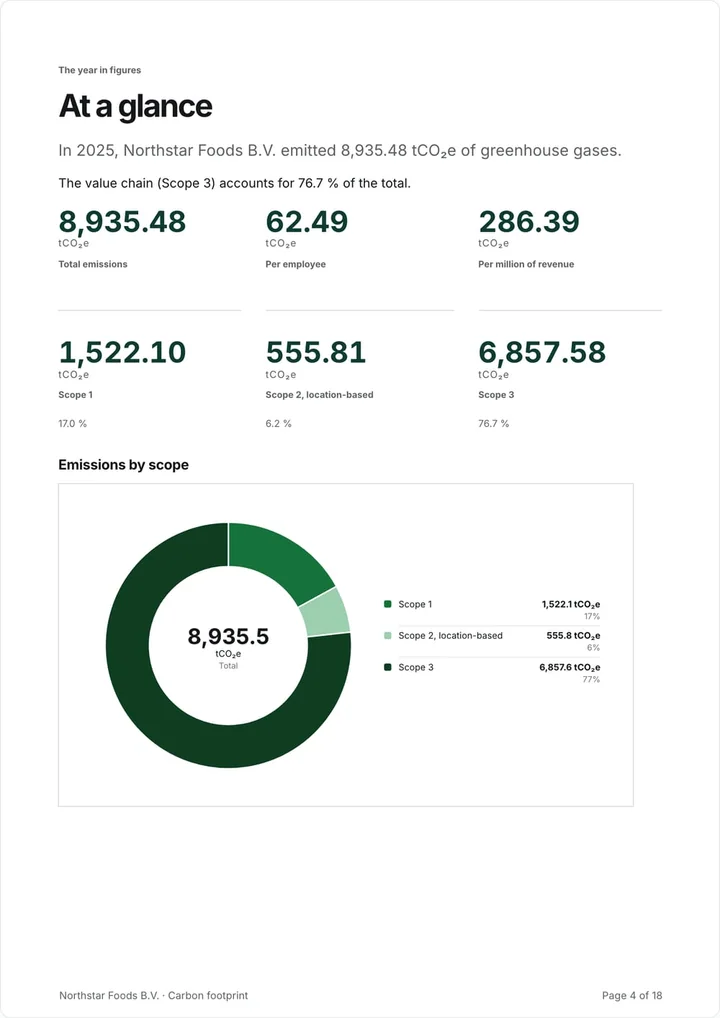
Our guides explain the EmpCo directive in full and how to back up the claims you keep. The figures behind a credible claim, such as emissions per unit or the change since a base year, come from a carbon footprint, which is what carbon accounting in Greener Ahead produces.
 Joost Thissen