Sustainability reports and customer questionnaires ask mainly for three governance policies: anti-corruption and bribery, whistleblowing and health and safety, plus usually a code of conduct, an environmental policy and a supplier code. In the EU, employers with 50 or more workers must have internal whistleblowing channels, and every employer must assess health and safety risks. The VSME asks which policies you have, whether they are public, and your convictions and fines for corruption.
Why policies come up in every questionnaire
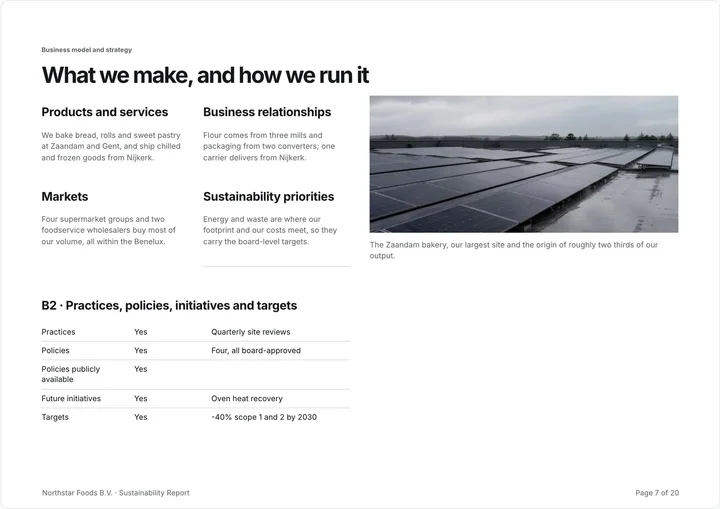
Customer questionnaires, bank ESG forms, EcoVadis and the EU voluntary standard (VSME) all ask whether you have written policies on certain topics. A policy shows that management has decided how the company behaves, who is responsible and how people can raise problems. The VSME asks which sustainability topics your policies cover, whether they are public and whether they have targets, and how many convictions and fines for corruption and bribery you had.
Anti-corruption and bribery
An anti-corruption policy says that the company does not offer, pay or accept bribes, directly or through agents. It sets rules for gifts, hospitality and donations, requires conflicts of interest to be declared, explains how to report suspicions, and names the consequences of breaking it. In the UK, the Bribery Act 2010 makes a company liable for failing to prevent bribery unless it had adequate procedures, so a policy with training and records is the core of its defence.
Whistleblowing
Under the EU Whistleblower Directive, Directive (EU) 2019/1937, private employers with 50 or more workers must set up internal reporting channels. Reports must be acknowledged within seven days and followed up with feedback within three months; the reporter’s identity is kept confidential, and retaliation is forbidden. Employers with 50 to 249 workers may share the resources for receiving and investigating reports. Each country has its own law, such as the Dutch Whistleblowers Protection Act, the German Whistleblower Protection Act, Spain’s Law 2/2023 and Italy’s Legislative Decree 24/2023.
Health and safety
Every employer in the EU must assess the risks to workers’ health and safety and take preventive measures, under the Framework Directive 89/391/EEC and national law. In the UK, employers with five or more employees must have a written health and safety policy. A good policy states management’s commitment, names who is responsible for what, and describes the arrangements: risk assessments, training, first aid, accident reporting and how often it is reviewed.
The other policies you will be asked about
Depending on your sector and customers, expect questions about these as well:
- A code of conduct covering human rights, including child labour, forced labour and discrimination.
- An environmental or sustainability policy.
- A supplier code of conduct.
- Data protection under the GDPR.
- Equal opportunities, diversity and anti-harassment.
What every policy needs
A policy that only exists on paper does not convince anyone. Each should have a purpose and scope, the people responsible, how it is put into practice and communicated, how concerns are raised, approval by management with a date, and a review date. Keep evidence that it is used: training records, the reports received and what was done with them.
Doing it in Greener Ahead
Greener Ahead does not write policies for you. Sustainability reporting in Greener Ahead prepares a VSME report that records which policies you have, whether they are public, your workforce and health and safety figures, and convictions and fines for corruption, with the document behind each answer. It costs €995 per year with unlimited users, and you can try it free for 14 days without a card. Check the pricing page for current details.
Policies at a glance
Which policies are legal duties and which are asked for by customers.
| Policy | Legal duty | Covers |
|---|---|---|
| Whistleblowing | EU: internal channels for 50 or more workers | Channels, seven-day acknowledgement, three-month feedback, no retaliation |
| Health and safety | EU: risk assessment for all employers; UK: written policy from five employees | Responsibilities, risk assessments, training, accident reporting |
| Anti-corruption and bribery | Not as such; UK Bribery Act rewards adequate procedures | Bribes, gifts, hospitality, conflicts of interest, reporting |
| Code of conduct and human rights | Expected by large customers | Child and forced labour, discrimination, working conditions |
| Environmental policy | Expected by customers and tenders | Commitments, objectives, responsibilities |
Check each policy against this list
Before you send it to a customer.
- It has a purpose, a scope and named responsibilities.
- Management approved it, with a date.
- Employees know it exists and where to find it.
- It explains how to raise a concern.
- It has a review date, and you keep evidence that it is used.
Sources and scope
- EUR-Lex: Directive (EU) 2019/1937 on the protection of persons who report breaches of Union law
- EUR-Lex: Council Directive 89/391/EEC on safety and health of workers at work
- legislation.gov.uk: Bribery Act 2010
These resources explain a preparation workflow. Check your selected standard and recipient requirements before sharing your report.
 Joost ThissenFounder