The ESRS (European Sustainability Reporting Standards) are the twelve standards companies use for their sustainability statement under the CSRD: ESRS 1 General requirements and ESRS 2 General disclosures, which apply to every company in scope, and ten topical standards on climate (E1), pollution (E2), water (E3), biodiversity (E4), resource use (E5), own workforce (S1), workers in the value chain (S2), affected communities (S3), consumers (S4) and business conduct (G1), reported when material. The revised ESRS of Delegated Regulation (EU) 2026/1563 apply from financial year 2027, with a choice of version for 2026.
What are the ESRS?
The European Sustainability Reporting Standards (ESRS) set out what a company reports in its sustainability statement under the Corporate Sustainability Reporting Directive (CSRD). The first set was adopted as Commission Delegated Regulation (EU) 2023/2772. A revised, simpler set replaced it through Delegated Regulation (EU) 2026/1563, which enters into force on 10 November 2026 and applies to financial years starting on or after 1 January 2027.
The ESRS apply to companies within the scope of the CSRD. Since Directive (EU) 2026/470, that means companies with more than 1,000 employees and a net turnover above €450 million. Smaller companies that report voluntarily, usually because a customer or a bank asks, use the VSME instead.
The twelve standards
The revised set keeps twelve standards: two cross-cutting standards that apply to every company in scope, and ten topical standards that apply when the topic is material.
- ESRS 1 General requirements: the rules for preparing the statement, including the double materiality assessment, the value chain and how information is presented.
- ESRS 2 General disclosures: the basis of preparation, governance, strategy and the materiality process, which every company reports, plus the general requirements for policies, actions, metrics and targets.
- Environment: E1 Climate change, E2 Pollution, E3 Water, E4 Biodiversity and ecosystems, E5 Resource use and circular economy.
- Social: S1 Own workforce, S2 Workers in the value chain, S3 Affected communities, S4 Consumers and end-users.
- Governance: G1 Business conduct.
How materiality decides what you report
Apart from ESRS 2, a company reports a topical standard only for the impacts, risks and opportunities that its double materiality assessment finds material. A topic can be material from the impact side, the financial side, or both.
The revised ESRS 1 allows a top-down approach: a company can decide at topic level, for example that climate change is material, without first scoring every sub-topic. It can also limit the work on the value chain to information available without undue cost or effort.
What changed from the 2023 ESRS
The regulation itself lists what the revision set out to do, and the reliefs it brings:
- Fewer datapoints, with quantitative datapoints preferred over narrative text.
- A clearer line between mandatory and voluntary datapoints.
- Clear instructions on how to apply materiality, including the top-down approach.
- Reliefs for acquisitions and disposals, non-significant activities, a partial value chain scope and joint operations.
- An executive summary, and the option to present the EU taxonomy disclosures in a separate appendix.
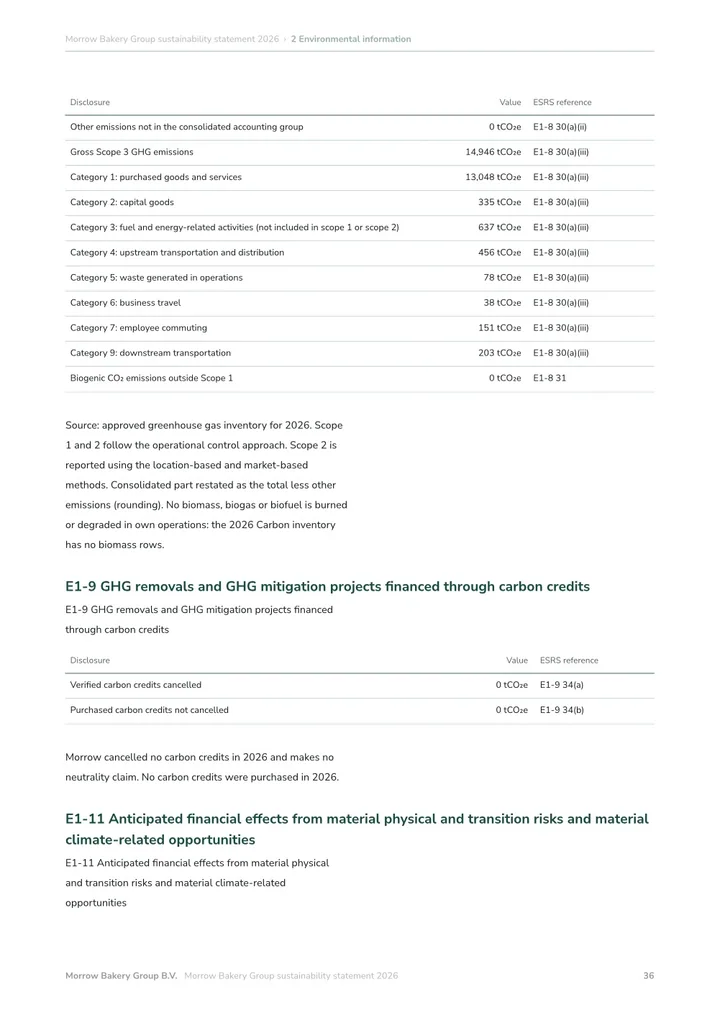
- More consistency with other EU law and with global standards, which changed some numbering: in E1, for example, emissions moved from E1-6 to E1-8.
Which version applies in which year?
For financial years starting in 2026, a company in scope can apply the 2023 ESRS as last amended by Delegated Regulation (EU) 2025/1416, the revised ESRS, or the 2023 ESRS with eight reliefs from the revised version, such as the top-down approach to materiality. It must state which version it applies. For financial years starting on or after 1 January 2027, only the revised ESRS apply.
Doing it in Greener Ahead
CSRD reporting in Greener Ahead follows the revised ESRS. It starts with your double materiality assessment, where you score impacts, risks and opportunities or decide a topic as a whole top-down, and then asks only for the disclosures of the topics you found material, with the evidence beside every answer for your assurer. Carbon accounting fills the E1 emissions disclosures from your approved footprint, and Climate strategy holds your targets. CSRD reporting costs €4,995 a year excluding VAT, with unlimited users and assurer seats, and you can try it free for 14 days without a card.
The revised ESRS at a glance
Most topical standards follow the same order: policies, actions and resources, targets, then metrics. E1, E4 and S1 have more, because they add a transition plan or a longer list of metrics.
| Standard | Topic | Disclosure requirements |
|---|---|---|
| ESRS 1 | General requirements | Rules for the whole statement, no disclosures of its own |
| ESRS 2 | General disclosures | BP-1 to BP-2, GOV-1 to GOV-4, SBM-1 to SBM-3, IRO-1 to IRO-2, and the general requirements for policies, actions, metrics and targets |
| E1 | Climate change | E1-1 to E1-11 |
| E2 | Pollution | E2-1 to E2-5 |
| E3 | Water | E3-1 to E3-4 |
| E4 | Biodiversity and ecosystems | E4-1 to E4-5 |
| E5 | Resource use and circular economy | E5-1 to E5-5 |
| S1 | Own workforce | S1-1 to S1-16 |
| S2 | Workers in the value chain | S2-1 to S2-4 |
| S3 | Affected communities | S3-1 to S3-4 |
| S4 | Consumers and end-users | S4-1 to S4-4 |
| G1 | Business conduct | G1-1 to G1-6 |
Sources and scope
- EUR-Lex: Commission Delegated Regulation (EU) 2026/1563 amending the ESRS
- EUR-Lex: Commission Delegated Regulation (EU) 2023/2772, the first set of ESRS
- EFRAG: European Sustainability Reporting Standards (ESRS)
These resources explain a preparation workflow. Check your selected standard and recipient requirements before sharing your report.
 Joost ThissenFounder