Spain’s Sustainable Mobility Act (Law 9/2025) requires companies and public bodies to have a sustainable mobility plan for travel to work at every workplace with more than 200 workers, or 100 per shift, by 5 December 2027. The plan starts from a diagnosis of how employees travel, sets measures such as public transport, cycling, car sharing and remote work, is negotiated with workers’ representatives and is reported to the authorities.
What the law requires
Law 9/2025 of 3 December on Sustainable Mobility was published in the Official State Gazette on 4 December 2025 and came into force the next day. Its article 26 requires companies and public sector bodies to have a sustainable mobility plan for travel to work at every workplace with more than 200 workers, or 100 per shift. The threshold applies per workplace, not to the company’s total headcount.
Employers have 24 months from the law’s entry into force, so until 5 December 2027, to put the plans in place. Plans adopted earlier under regional rules must be updated to the new criteria.
What goes in a plan
A sustainable mobility plan for travel to work is a set of measures, promoted by the management of the workplace, to make commuting and work travel more sustainable for employees, and where relevant for customers, suppliers and visitors. It starts from a diagnosis of how people travel today. The law points to measures such as:
- Walking and cycling, with safe routes, parking and showers.
- Public transport and collective transport, such as company shuttles.
- Car sharing and other shared mobility.
- Low-emission and zero-emission vehicles, with charging points.
- Working from home where the job allows it.
- Road safety measures to prevent accidents on the way to work and during work travel.
Negotiation and reporting
The plan is negotiated with the workers’ legal representatives or, where there are none, with a committee of the most representative trade unions. Once approved, it is communicated to the competent authority within three months, for inclusion in the national mobility data space. Employers then report on how the plan is being carried out, first within 24 months of approval and every two years after that. Failing to have a plan or to report on it can be fined.
Measuring commuting
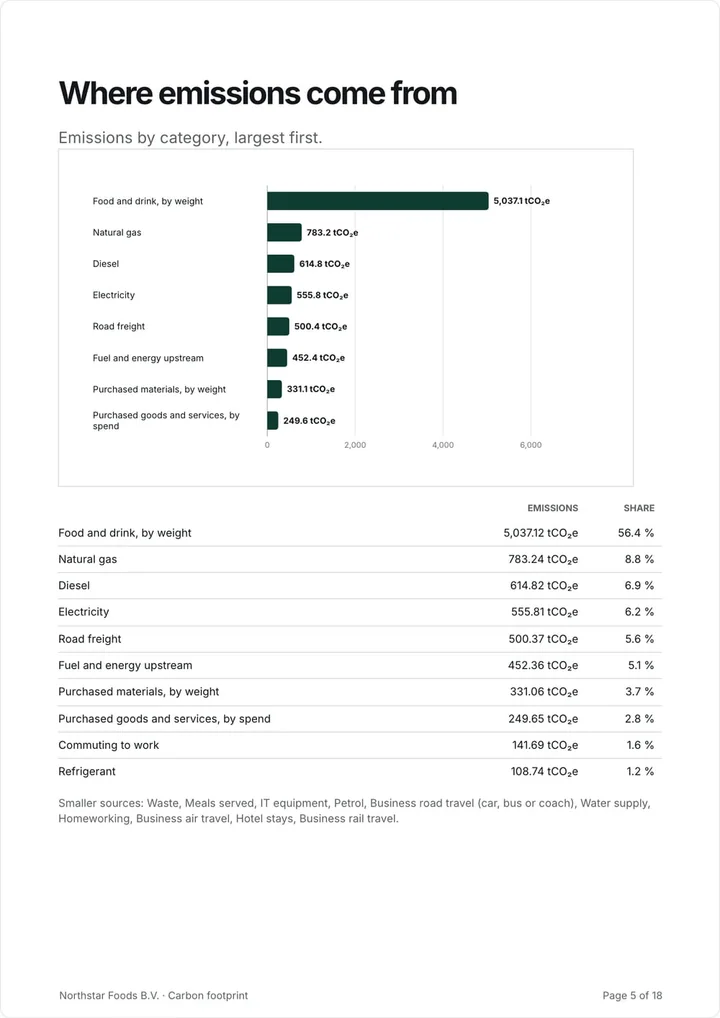
The diagnosis needs data: where employees live, how they travel, how far, and how often they work from home. A short employee survey gives you that, and the same figures produce the emissions of commuting, Scope 3 category 7 under the GHG Protocol. Business travel by employees is category 6. Measuring before and after the measures shows whether the plan works, which the progress reports ask for.
Doing it in Greener Ahead
Greener Ahead does not draft or file mobility plans. Carbon accounting in Greener Ahead measures commuting and business travel as part of your footprint: employees answer a short commuting survey without an account, and the result shows the emissions by mode of transport, year on year. It costs €1,495 per year with unlimited users, and you can try it free for 14 days without a card. Check the pricing page for current details.
The plan at a glance
The main rules of article 26.
| Rule | What it means |
|---|---|
| Who | Companies and public bodies, per workplace with more than 200 workers or 100 per shift |
| Deadline | 5 December 2027, 24 months after the law came into force |
| Content | Diagnosis and measures for commuting and work travel, including road safety |
| Negotiation | With the workers’ legal representatives, or the most representative unions |
| Communication | To the competent authority within three months of approval |
| Progress reports | Within 24 months of approval, then every two years |
Steps to a first plan
A workable order for the first plan.
- List your workplaces and count the workers per workplace and per shift.
- Survey employees on where they live, how they travel and how often they work from home.
- Calculate the commuting emissions as the baseline.
- Choose measures with the workers’ representatives and agree a target.
- Approve the plan, send it to the authority within three months and repeat the survey before the first progress report.
Sources and scope
- BOE: Law 9/2025 of 3 December on Sustainable Mobility
- GHG Protocol: Technical Guidance for Calculating Scope 3 Emissions
These resources explain a preparation workflow. Check your selected standard and recipient requirements before sharing your report.
 Joost ThissenFounder