CO₂ equivalent (CO₂e) expresses all greenhouse gases as the amount of CO₂ that would cause the same warming, so they can be added up. Multiply the kilograms of each gas by its global warming potential (GWP) over 100 years: 1 for CO₂, 27 to 30 for methane and 273 for nitrous oxide in the latest IPCC values, and hundreds to thousands for many refrigerants. Use one set of values for all scopes and years.
Why CO₂ equivalent
Greenhouse gases trap different amounts of heat and stay in the atmosphere for different lengths of time. To add them up into one footprint, each gas is converted into the amount of carbon dioxide that would cause the same warming. The result is CO₂ equivalent, written CO₂e, and company footprints are reported in tonnes of CO₂e.
What global warming potential is
Global warming potential (GWP) compares the warming caused by one kilogram of a gas over a period with that of one kilogram of CO₂, which has a GWP of 1. The GHG Protocol requires values over 100 years. The calculation is simple: kilograms of gas multiplied by its GWP gives kilograms of CO₂e.
A footprint under the GHG Protocol covers seven gases or groups of gases: carbon dioxide, methane, nitrous oxide, hydrofluorocarbons (HFCs), perfluorocarbons (PFCs), sulphur hexafluoride and nitrogen trifluoride.
Which values to use
The values come from the assessment reports of the Intergovernmental Panel on Climate Change (IPCC) and change as the science improves. In the fifth report (AR5), methane has a GWP of 28 and nitrous oxide 265. In the sixth report (AR6), methane from fossil sources has 29.8, methane from other sources 27.0, and nitrous oxide 273.
The GHG Protocol recommends the most recent values and asks you to use one report consistently for all scopes and all years, including your base year. Most published emission factors for fuels and electricity are already expressed in CO₂e, so check which IPCC report the publisher used and note it in your method.
Refrigerants: small leaks, large numbers
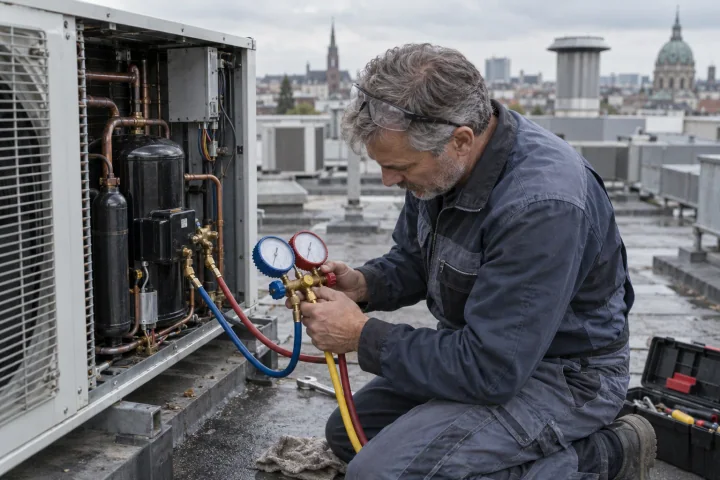
Many refrigerants used in air conditioning, heat pumps and cold stores are HFCs with GWPs in the hundreds or thousands. HFC-134a has a GWP of 1,530 in AR6, so one kilogram leaking out equals 1.53 tonnes of CO₂. A refrigerant top-up of a few kilograms can weigh as much as months of driving a company car.
Leaks from equipment you own or control count under Scope 1. The usual way to measure them is the amount refilled during the year, taken from maintenance reports.
Methane and nitrous oxide
Methane comes from livestock, landfill, manure and leaks of natural gas; nitrous oxide from fertiliser and some combustion. For farms and food producers they can be the largest part of the footprint. For most other companies they appear as a small share inside the emission factors for burning fuel.
Doing it in Greener Ahead
Carbon accounting in Greener Ahead reports every source in tonnes of CO₂e, from fuel and electricity to refrigerant losses, with the emission factor, source and edition shown beside every figure. It costs €1,495 per year with unlimited users, and you can try it free for 14 days without a card. Check the pricing page for current details.
Common greenhouse gases and their GWP
100-year values from the last two IPCC assessment reports.
| Gas | Typical sources | GWP in AR5 | GWP in AR6 |
|---|---|---|---|
| Carbon dioxide (CO₂) | Burning fuel, some industrial processes | 1 | 1 |
| Methane (CH₄) | Livestock, landfill, natural gas leaks | 28 | 27.0, or 29.8 from fossil sources |
| Nitrous oxide (N₂O) | Fertiliser, some combustion | 265 | 273 |
| HFC-134a | Vehicle air conditioning, refrigeration | 1,300 | 1,530 |
| Sulphur hexafluoride (SF₆) | Electrical switchgear | 23,500 | 25,200 |
How to calculate CO₂e from a refrigerant leak
The same four steps work for any refrigeration or air-conditioning unit.
- Find the refrigerant type on the unit’s nameplate or in the maintenance report.
- Take the kilograms refilled during the year as the amount that leaked.
- Look up its GWP; for a blend, use the published value for the blend.
- Multiply: 4 kg of a refrigerant with a GWP of 2,000 is 8,000 kg, or 8 tonnes of CO₂e, reported under Scope 1.
Sources and scope
- GHG Protocol: Global Warming Potential values (August 2024)
- IPCC: Sixth Assessment Report, Working Group I, chapter 7
- GHG Protocol: Corporate Accounting and Reporting Standard
These resources explain a preparation workflow. Check your selected standard and recipient requirements before sharing your report.
 Joost ThissenFounder